
Skil TS6307-00 Review: Portable Table Saw Design and Tradeoffs
INFO
Evidence Level: Level 1 — Document Lab + Owner Feedback Review
Evidence note: This review is based on Skil documentation, official specifications, independent reviews, and owner feedback.
The 10-inch, 15-amp jobsite table saw category is often compared around higher-priced models from DeWalt and Bosch. The Skil TS6307-00 enters this space as a budget-conscious alternative that includes a rack-and-pinion fence, which is one of the most meaningful upgrades in budget portable saws.
When a saw costs significantly less than the category leaders, the mechanical differences usually show up in the stand design, table refinement, and overall capacity. Based on official specifications, independent reviews, and long-term ownership feedback, here is how the TS6307-00 balances price and performance.
- Best for: DIYers, garage woodworkers, first table saw buyers, and renovation work.
- Avoid if: You need wheeled mobility, 3/4-inch dado work in one pass, permanent bench integration, or larger rip capacity.
- Key tradeoff: Strong fence value, but smaller capacity and less refined stand flexibility than premium jobsite saws.
The Rack-and-Pinion Fence System
Most budget jobsite saws use a sliding clamp-style fence. You push the fence along a rail, clamp the front, and hope the back aligns parallel to the blade.
The Skil TS6307-00 uses a rack-and-pinion fence system. Both the front and rear of the fence are connected to gears that run along a toothed track. When you turn the adjustment knob, both ends of the fence move simultaneously. Mechanically, this dramatically reduces the chance of the fence binding or locking down at an angle.
However, the lower price means the rack mechanism should be treated as a maintenance-sensitive part. Keeping the rails and teeth clean helps reduce unnecessary wear on the adjustment mechanism over time, rather than forcing the knob through sawdust buildup.
Motor and Cutting Capability
The saw is powered by a standard 15-amp direct-drive motor spinning a 10-inch blade at 4,600 RPM.
Rip Capacity
The rails extend to offer 25-1/2 inches of right-side rip capacity. This is enough to rip a 4x8 sheet of plywood down the middle, though supporting a full sheet on a lightweight saw requires external outfeed support.
Dado Capacity Limitations
A significant mechanical constraint on this saw is the arbor length. According to Skil’s specifications for both the saw and their official STA6307 insert, the TS6307-00 can only accept an 8-inch dado stack up to 5/8-inch wide.
Since 3/4-inch plywood is a standard material in shop projects, this does not make dado work impossible, but it makes 3/4-inch grooves a two-step operation. If heavy dado use is part of your workflow, this adds setup friction.
Blade and Riving Knife Considerations
The included riving knife has specific thickness requirements to prevent kickback. The blade kerf must be wider than the knife, and the blade plate must be thinner. If you upgrade to an ultra-thin kerf aftermarket blade, ensure it matches standard jobsite specifications so it does not bind against the factory riving knife.
The Integrated Stand Tradeoff
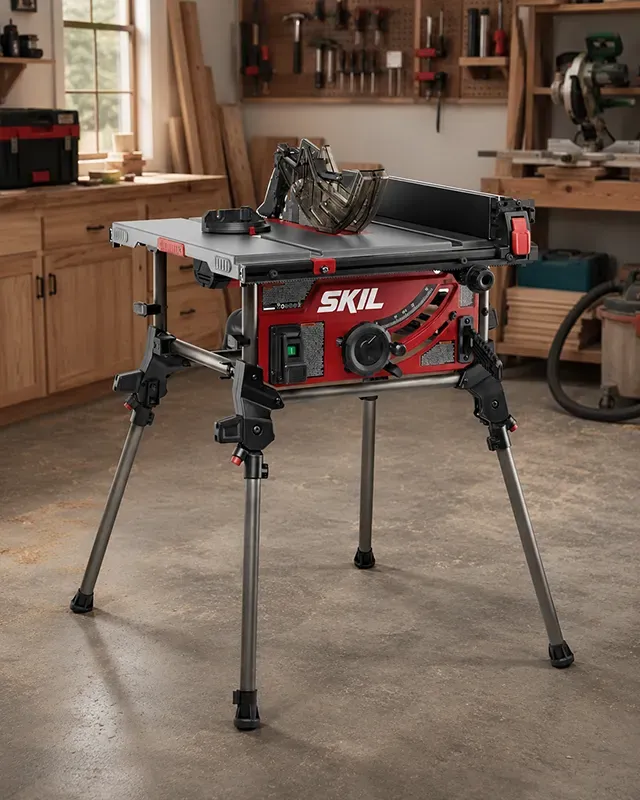
Instead of bolting to a separate rolling stand or a scissor frame, the TS6307-00 features integrated steel folding legs built directly into the lower frame.
Strengths:
- Weight: The entire unit weighs just under 50 pounds, making it manageable to load into a truck.
- Storage: The splayed leg design folds up into a very compact footprint.
- Rigidity: The stance creates a rigid base for rip cuts compared to cheap aluminum scissor stands.
Limitations: Because the stand is part of the saw’s storage and support concept, this is not the cleanest saw to drop into a custom bench compared with a saw that separates from a stand. Unbolting the legs requires modifying the base, which defeats the portability it was designed for.
Ownership Friction and Common Upgrades
Long-term feedback and independent testing highlight a few consistent areas of friction:
- Throat Plate: A common owner complaint is that the factory insert feels thin and can flex under pressure. An aftermarket or custom MDF zero-clearance insert is a common early upgrade and is worth budgeting for if you cut thin stock or dadoes.
- Miter Gauge: Like most stock miter gauges in this price tier, the included gauge is loose in the T-slot and lacks precision. An aftermarket miter gauge or a crosscut sled is recommended for accurate crosscuts.
- Table Flatness: One independent review measured about 1/32 inch of table variance. This is not shocking for a coated cast-aluminum jobsite table, but it matters more for precision joinery than it does for framing or renovation cuts.
Where It Falls Short of DeWalt and Bosch
If you are comparing this to category leaders like the DeWalt DWE7491RS or the Bosch 4100 series, the price difference buys you several mechanical upgrades on the premium models.
First, DeWalt offers a larger 32-1/2 inch rip capacity compared to Skil’s 25-1/2 inches. Second, premium saws generally offer fully modular wheeled stands (like the Bosch Gravity-Rise) that make moving the saw around a shop or jobsite effortless, whereas the Skil requires you to carry it. Finally, the Skil is built strictly as a value platform; it lacks some of the capacity and stand refinement found on more expensive jobsite models, including wider dado support on saws that allow up to 13/16 inch.
Final Verdict
The Skil TS6307-00 is not a premium jobsite saw pretending to be cheap. It is a value-focused portable saw that puts money into the feature most beginners feel immediately: the fence. Its limits are real—no wheels, 5/8-inch dado capacity, basic miter gauge, and less workstation flexibility—but those limits are understandable at this price.
For a garage shop or as a first table saw, it makes sense. For frequent transport, wide dado work, or a permanent bench build, DeWalt or Bosch-class saws are easier to justify.