
SawStop Jobsite Pro Review: Safety, Portability, and Tradeoffs
INFO
Evidence Level: Level 1 — Document Lab + independent review and owner-feedback synthesis.
This review is based on SawStop documentation, published specifications, independent review observations, and public owner feedback. WoodGearLab has not physically tested this saw.
For woodworkers operating out of a one-car garage or traveling to jobsites, the portable table saw market usually forces a difficult choice: accept the inherent risks of a lightweight portable table saw, or give up entirely on mobility to get the safety and mass of a cabinet saw.
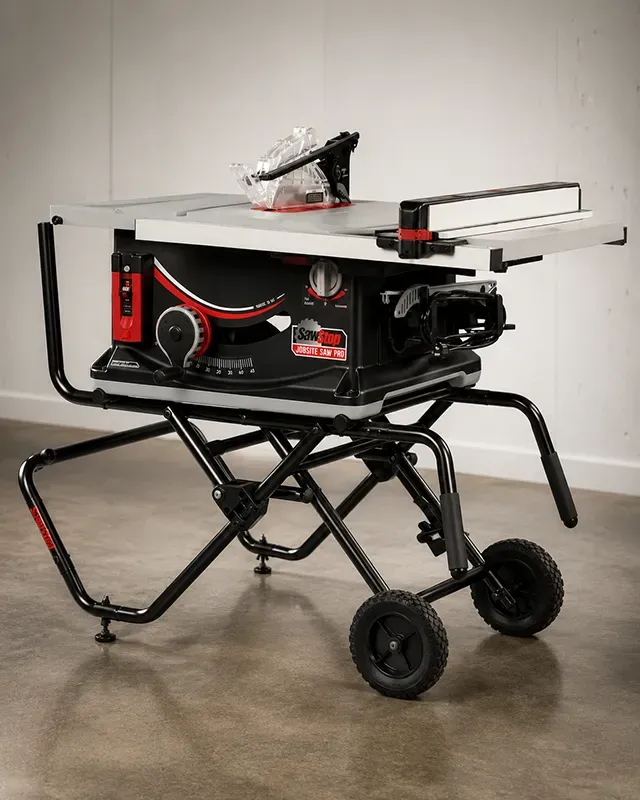
The SawStop Jobsite Saw Pro (JSS-120A60) exists specifically to bridge that gap. It packs SawStop’s flesh-detecting brake system into a folding portable chassis. However, at roughly $1,700, it costs far more than most premium jobsite saws from brands like DeWalt or Bosch.
Based on manufacturer documentation, mechanical analysis, and long-term ownership feedback, here is a detailed look at how the Jobsite Saw Pro performs, where the design is strongest on paper and in published review feedback, and the mechanical tradeoffs you accept for portable safety.
The Mechanical Reality of the AIM System
The core reason this saw exists is SawStop’s Active Injury Mitigation (AIM) system. A small electrical signal is constantly monitored on the blade. Because the human body is conductive, skin contact causes a drop in that signal. Within roughly 5 milliseconds, a heavy spring fires an aluminum brake block into the spinning blade, halting its momentum and using that kinetic energy to pull the entire arbor block below the table.
Manufacturer documentation and many public owner reports support the core claim that the system can dramatically reduce blade-contact injury severity. However, the outcome still depends on the type of contact, blade speed, material, and whether the saw is operating in normal mode. Ownership introduces specific operational realities.
The Cost of a “Save”
When the safety system activates, the brake cartridge is consumed and the blade is often damaged or replaced. That means an activation is not only a safety event; it is also an ownership-cost event. Depending on current cartridge and blade pricing, one activation can mean replacing both the brake cartridge and the blade.
Bypass Mode Is Not a Convenience Mode
Very wet wood, wet pressure-treated lumber, or other conductive materials can trigger the system or require a conductivity check. SawStop provides bypass mode for these cases, but in bypass mode, the brake protection is intentionally disabled.
Bypass mode should be treated as a temporary diagnostic and material-specific mode, not a normal cutting mode. If the saw is in bypass mode, the central safety feature you paid for is not active. That makes guard use, riving knife use, push-stick technique, and body position even more important, not less.
What the Brake Does Not Fix
It is critical to understand what the SawStop brake cannot do. It detects flesh contact. It does not detect table saw kickback.
If a board pinches against the back of the blade, the blade can still throw the workpiece back at the operator at high speed. The SawStop mechanism will not deploy during a kickback event unless your hand is dragged into the blade during the process. A riving knife, proper push sticks, and sound body positioning remain absolutely mandatory. The safety premium you are paying for is blade-contact mitigation, not a substitute for fundamental table saw safety.
Fence Design and Adjustments
While the safety system dominates the conversation, the mechanical adjustments on the Jobsite Pro are highly refined for a portable saw.
The Hi-Low T-Style Fence
Many modern portable saws rely on a rack-and-pinion fence system to keep the fence parallel to the blade. SawStop opted for a scaled-down version of a T-style fence, modeled after their cabinet saws. The fence clamps firmly to the front rail using their ErgoLock paddle.
To achieve its 25-1/2 inch right-rip capacity, the table itself features an extension wing that slides outward on rails. The fence includes a flip-down low-profile face, which allows for safer feeding of thin stock by giving your hands and push sticks more clearance under the blade guard. Independent reviews consistently note that this fence remains rigid and parallel, though you must ensure the sliding table extension is locked down squarely to maintain accuracy.
One-Turn Elevation
Standard jobsite saws use a threaded rod to raise and lower the arbor, often requiring 20 to 30 cranks to reach full blade height.
The Jobsite Pro uses a unique internal gearing mechanism that achieves full blade elevation in a single turn of the handwheel. This is a massive workflow improvement, allowing for rapid depth changes without endless cranking. Micro-adjustments for the bevel angle are handled by a secondary dial behind the main handwheel, offering granular control over the tilt.
Power, Capacity, and Tradeoffs
Because it must run on a standard 120V household outlet, the Jobsite Pro uses a 15-amp universal motor.
Universal Motor Limitations
Universal motors use carbon brushes and run at extremely high RPMs (geared down to spin the arbor at 4,000 RPM). They are loud, aggressive, and lack the sustained torque of the heavy induction motors found on stationary cabinet saws.
Published review testing reports good performance in plywood, dado work, and hardwood ripping, while thicker 8/4 hard maple required a slower feed rate. This fits the mechanical profile of a 15-amp universal-motor jobsite saw: capable for portable work, but not a substitute for the quieter, higher-mass cutting experience of a stationary induction-motor saw.
Dado Support and Ownership Costs
Dado work is supported (up to an 8-inch dado stack with a maximum width of 29/32 inch), but it is not just a blade swap. The saw requires the correct dado cartridge and a dado zero-clearance insert. That matters because the SawStop ownership model includes safety-system-specific accessories, not only generic 10-inch table saw blades.
The Table and Portability
The table is made of coated aluminum, not cast iron. SawStop lists the diagonal flatness tolerance at 0.033 inches. For jobsite carpentry, plywood breakdowns, and many garage-shop furniture tasks, this tolerance is likely adequate. However, for extreme precision joinery, it will never match the dead-flat stability of a milled cast-iron top.
At 113 pounds with the mobile cart attached, the “portable” label comes with a caveat. The pedal-actuated folding stand acts as an excellent dolly, making it easy to roll across a garage floor or jobsite terrain. But lifting 113 pounds into the back of a pickup truck solo is difficult. If you must move the saw frequently in and out of a vehicle by yourself, the lighter SawStop Compact Table Saw (at 68 pounds) might be a better physical match, though it sacrifices the mobile cart and some rip capacity.
Dust Collection
The Jobsite Pro is unusually well-equipped for dust management in the jobsite category. It features a dust shroud around the blade under the table, leading to a 2-9/16” port. The saw also includes an Active Dust Collection Blade Guard with its own 1-11/16” port on top. When connected to a shop vacuum with a Y-splitter, the combination of under-table and over-table extraction is stronger than most basic jobsite-saw setups, though some fine dust will still escape.
Who This Saw Makes Sense For
The SawStop Jobsite Saw Pro is an expensive, highly engineered compromise.
Who should consider it:
- Space-constrained woodworkers who work in shared garages and must fold their tools away.
- Professionals and schools where safety and liability mitigation are the absolute highest priorities.
- Buyers who want premium features (one-turn elevation, excellent active dust collection) but lack the 220V power required for larger stationary saws.
Who should skip it:
- Woodworkers with dedicated space. For a similar price, you can purchase a hybrid or contractor saw with a cast-iron top and a quieter induction motor, provided you accept the lack of flesh-detecting safety.
- Highly mobile contractors who must constantly lift their saw into a truck bed solo (the weight makes this punishing over time).
Mechanically, the Jobsite Pro mostly delivers on its core promise: SawStop blade-contact mitigation in a capable portable chassis, with the cost, weight, and aluminum-table limitations that come with that compromise.