
Freud LU83R010 Review: Thin-Kerf Combination Blade Tradeoffs
INFO
Evidence Level: Level 1 - Document Lab + Owner Feedback Synthesis.
Review Basis
This review is based on manufacturer specifications, retailer documentation, blade geometry analysis, and owner-feedback synthesis. WoodGearLab has not physically tested this blade yet, so cut-quality and durability claims are treated as reported feedback or mechanical expectations, not measured lab results.
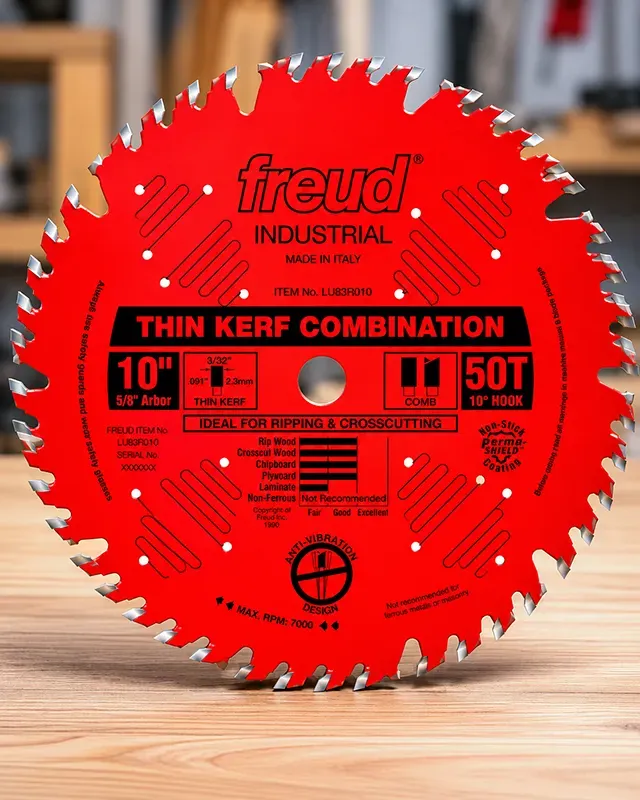
The Freud LU83R010 is a 10-inch, 50-tooth thin-kerf combination blade that makes the most mechanical sense on lower-powered jobsite and contractor-style table saws, where reducing kerf width can reduce cutting load. It uses a specialized tooth grind to handle both ripping and crosscutting without requiring constant blade changes.
Based on specifications and mechanical analysis, this blade is designed to balance dual workflows rather than maximize either ripping speed or crosscut finish. However, its specific geometry introduces strict table saw setup requirements and potential safety contradictions for other types of saws that buyers must understand before mounting it. For broader blade selection by cut type, see our guide to table saw blades by cut type.
The Mechanical Logic of the 50T Combination Grind
To understand why this blade behaves differently from a dedicated rip or crosscut blade—and to see how it fits into the broader concepts of table saw blades explained—start with the grind. Most dedicated rip blades use 24 to 30 teeth with a Flat Top Grind (FTG) to clear material quickly. Dedicated crosscut blades use 60 to 80 teeth with an Alternate Top Bevel (ATB) grind to slice across wood fibers cleanly.
The LU83R010 attempts to split the difference using a specific tooth count and layout. The 50 teeth are grouped in a repeating pattern: four ATB teeth followed by one flat raker tooth (4 ATB + 1 Flat). For related 50T combination-blade examples, see our Diablo D1050X review and CMT combination blade review.
This design matters mechanically. The four ATB teeth score the wood fibers to reduce tear-out during crosscuts, while the flat raker tooth acts like a chisel to clear the gullet and stabilize the cut during ripping. The large gullets separating these five-tooth groupings provide the necessary chip clearance so the blade does not bind during long rips in hardwood.
While the flat raker tooth leaves a relatively flat bottom compared to an ATB-only blade, the alternating ATB teeth will still leave small angled scores on the outer edges of the kerf. Because of this geometry, the LU83R010 is not a replacement for a true FTG blade if you need perfectly flat-bottomed grooves for joinery.
Thin Kerf Tradeoffs: Motor Load vs. Deflection
The LU83R010 features a 0.091-inch kerf and a 0.071-inch plate thickness. Standard full-kerf blades typically measure around 0.125 inches at the tooth.
Using a thin-kerf blade mechanically reduces the amount of material removed per pass by roughly 25%. For owners of 15-amp jobsite saws or 1.5 to 1.75 HP contractor saws, this reduction can noticeably decrease cutting load. The saw motor is less likely to bog down, which can help maintain RPM and reduce one cause of heat and burning when feed rate, blade sharpness, and setup are also correct.
The mechanical tradeoff for a thinner plate is a higher susceptibility to deflection. A 0.071-inch steel plate is inherently more prone to wobbling under heavy lateral load or extreme heat. Freud incorporates laser-cut anti-vibration slots to help keep the blade stable during normal use, but forcing a fast feed rate through dense stock can still induce flutter and leave saw marks on the cut edge.
The Riving Knife Compatibility Constraint
Table saw riving knives must follow a strict dimensional rule: the knife must be thinner than the blade’s kerf, but thicker than the blade’s plate.
Owner discussions around thin-kerf blades repeatedly point to the same compatibility issue: if the riving knife is thicker than the blade kerf, the workpiece can bind behind the cut. With the LU83R010’s 0.091-inch kerf and 0.071-inch plate, the riving knife should measure safely above the plate thickness and below the actual measured kerf. In practical terms, that usually means roughly 0.073 to 0.089 inches, but the blade and knife should be measured directly.
Many modern table saws ship with factory riving knives that measure around 0.090 to 0.094 inches thick. Mounting this blade on a saw with an oversized riving knife creates an immediate pinch hazard. This is not a detail to assume—measure your table saw’s riving knife with digital calipers before buying this blade.
Safety Considerations: Radial Arm Saws and Hook Angle
Some retailer listings include radial arm saws in the machine-use field for the LU83R010, but this should not be treated as a safe default.
The LU83R010 has a 10-degree positive hook angle. The positive rake is ideal for table saws because it helps pull the wood downward into the table for stability. However, for pull-through machines such as radial arm saws and sliding miter saws, negative-hook blades are generally preferred because they reduce aggressive self-feeding and the risk of the blade climbing the material.
By comparison, Freud’s LU91R010—a blade specifically designed for sliding miter saws—uses a 5-degree negative hook to push the workpiece down and back against the fence. Unless your saw manual and blade documentation explicitly approve a 10-degree positive hook setup, the LU83R010 should be treated strictly as a table saw blade, not a radial arm saw blade.
Who Should Consider It
- Jobsite and Contractor Saw Owners: The 0.091-inch kerf limits the physical cutting resistance, helping 1.5 HP to 1.75 HP motors maintain speed in dense materials.
- General Purpose Woodworkers: If you primarily build furniture or cabinets and dislike the workflow interruption of swapping between dedicated rip and crosscut blades, the 4 ATB + 1 Flat combination grind balances both tasks reasonably well.
- Plywood Users: The 50-tooth count and ATB teeth provide clean enough cuts on veneer plywood for most non-critical cabinet construction.
Who Should Skip It
- Radial Arm Saw Owners: The 10-degree positive hook angle makes this blade mechanically aggressive for pull-through machines.
- 3 HP+ Cabinet Saw Owners: High-power saws do not need the motor-load relief of a thin kerf. A full-kerf combination blade will offer better mass, heat sink capacity, and stability without riving knife compatibility headaches.
- Box Joint and Dado Workers: The ATB teeth leave scored corners in the cut. A dedicated flat-top grind (FTG) blade or a proper dado blade is required for clean, square socket bottoms when cutting a box joint.
Verdict
The Freud LU83R010 makes the most sense as a general-purpose thin-kerf blade for lower-powered table saws where reducing cutting load matters more than maximum blade mass. Its 50T combination grind is mechanically well suited to mixed ripping and crosscutting, especially for woodworkers who do not want to change blades constantly.
The main reason to hesitate is not the tooth design—it is compatibility. The 0.091-inch kerf gives this blade its motor-load advantage, but it also narrows the acceptable riving knife range. Before buying, measure your riving knife. If your saw already has a thick factory knife or you use a 3 HP cabinet saw, a full-kerf combination blade may be the cleaner long-term choice.