
Forrest Woodworker II Review: Premium Blade Design Tradeoffs
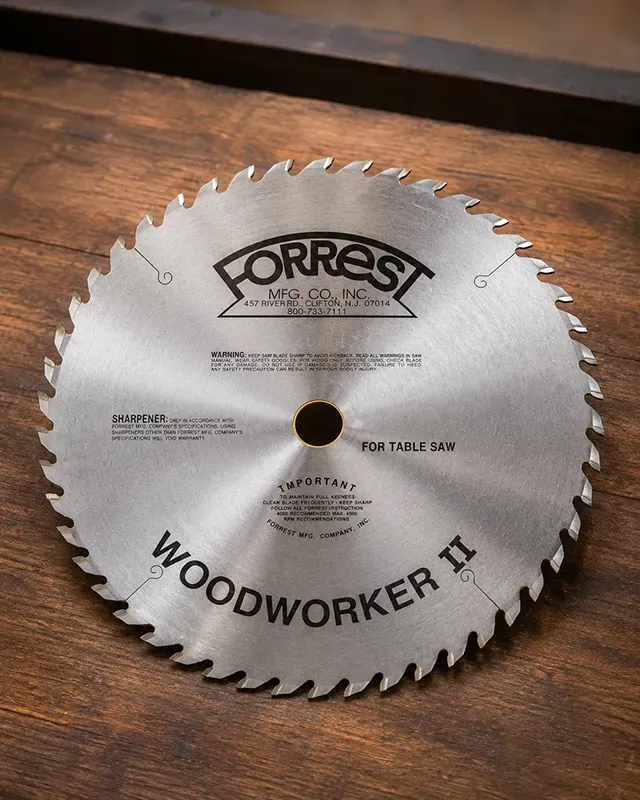
In the landscape of table saw blades, the Forrest Woodworker II is often treated as the premium reference point. Designed as an all-purpose / general-purpose blade rather than a traditional 50-tooth ATBR combination blade, the Woodworker II aims to handle most ripping and crosscutting without constant blade changes.
At more than double the price of standard big-box store blades, it carries high expectations. But a saw blade is ultimately a consumable cutting tool governed by geometry, metallurgy, and vibration control.
Based on manufacturer documentation, mechanical analysis, and long-term owner feedback, this review breaks down how the Woodworker II achieves its cut quality, where its design limits lie, and whether the premium price makes sense for your workshop.
The Mechanical Design: Carbide and Geometry
The standard Forrest Woodworker II is a 10-inch, 40-tooth blade. Its performance is largely dictated by three primary mechanical factors: carbide quality, tooth geometry, and plate manufacturing.
C-4 Micro-Grain Carbide
Many mass-market woodworking blades use lower-grade or less finely finished carbide than premium blades. Forrest positions the Woodworker II around C-4 micro-grain carbide, which is part of its long-term sharpening and edge-retention argument.
Mechanically, finer carbide and cleaner grinding can support a sharper cutting edge. That helps explain why many owners describe the Woodworker II as leaving unusually smooth rip and crosscut surfaces, especially on a well-aligned saw.
The tradeoff is that harder carbide is inherently more brittle. While the blade is designed for long edge life in clean hardwoods and softwoods, it is more susceptible to chipping if it strikes a hidden nail, a loose staple, or a severely hardened knot.
Furthermore, Forrest brazes significantly larger carbide blocks onto their plates than standard manufacturers. The larger carbide tips are part of the long-term value argument because they allow multiple professional sharpenings before the blade is worn out.
ATB geometry and Face Hook Angle
The standard Woodworker II features a 15-degree Alternate Top Bevel (ATB) geometry paired with a steep 20-degree face hook angle.
- The 15-degree ATB: This means the teeth alternate pointing slightly left and slightly right, acting like tiny scoring knives to sever wood fibers before clearing them out. This geometry allows the blade to crosscut veneered plywood with minimal tear-out, a task usually reserved for higher-tooth-count blades.
- The 20-degree face hook: A positive hook angle dictates how aggressively the blade pulls the material into the cut. A 20-degree hook reduces feed resistance, making long rip cuts through thick stock feel highly efficient.
However, this aggressive geometry means the blade has a lower tolerance for user error. If your fence is slightly misaligned, or if you pause mid-cut in cherry or maple, the aggressive teeth can quickly cause friction burns on the wood.
Plate Tensioning and Runout
Perhaps the most critical difference between a budget blade and a premium blade is what happens in the steel plate at 4,000 RPM.
Centrifugal force causes steel plates to stretch and distort while spinning, which induces harmonic vibration, or “flutter.” Flutter creates lateral runout—meaning the teeth wiggle side-to-side inside the kerf. This is what causes the arced scoring marks on the edge of a ripped board.
Forrest utilizes hand-tensioning on their steel plates, physically adjusting the steel to counteract centrifugal distortion at operating speed. Manufacturer and retailer specifications commonly emphasize very low side wobble, and long-term owner discussions often connect the Woodworker II’s value to smooth tracking on a well-tuned saw. WoodGearLab has not independently measured runout on this blade yet, so this review treats runout as a document-level and owner-feedback signal rather than a verified lab result.
Because a well-tensioned blade is designed to track with less lateral movement, the teeth are less likely to scrape the side of the kerf compared with a lower-control blade on the same saw.
Note: A premium blade cannot fix a bad saw. If your table saw arbor has inherent runout, or your fence is not parallel to the miter slot, the blade will still leave marks and burn the wood.
Full Kerf vs. Thin Kerf
The Woodworker II is available in standard (1/8-inch) and thin (3/32-inch) kerfs, with Forrest also offering an ultra-thin 5/64-inch version that requires a dedicated blade stiffener for deep cuts. The choice between thin kerf and full kerf blades depends entirely on your saw’s motor.
- Full Kerf (1/8”): Offers more plate stiffness and vibration resistance than the thin-kerf version. However, it removes 33% more material than a thin kerf blade, requiring significantly more power. Full kerf blades are best suited for 3-horsepower cabinet saws.
- Thin Kerf (3/32”): Reduces the workload on the motor. This is usually the safer match for 15-amp jobsite saws, contractor saws, or 1.75-horsepower hybrid saws. Because the plate is thinner, it is slightly more prone to deflection under heavy lateral loads, but Forrest’s tensioning helps minimize this tradeoff.
Long-Term Ownership and Maintenance
Evaluating the Woodworker II requires looking at long-term ownership friction.
A significant part of the Forrest ecosystem is their factory sharpening service. Because the C-4 carbide requires specialized diamond wheels to hone properly without altering the original angles, taking a Woodworker II to a low-quality or poorly set up sharpening service can degrade its performance.
Many long-term owners treat Forrest’s sharpening service as part of the blade’s value proposition, because it preserves the intended tooth geometry better than a generic sharpening job. Regular maintenance, such as clearing resin buildup, is also critical to preserving the cut quality between sharpenings.
The friction point is logistics. Shipping a blade out for service typically means a turnaround time of about 1 to 2 weeks, plus shipping time. Many long-term owners eventually purchase a second blade to use while the primary is out for maintenance, pushing the total system investment quite high.
Tradeoffs and Final Verdict
The Forrest Woodworker II is designed to deliver high-level cut quality across a wide variety of operations by combining premium materials with rigorous manufacturing tolerances.
Who it makes sense for:
- Woodworkers who want a single, highly capable blade for the vast majority of their cuts.
- Owners of well-tuned table saws looking to minimize jointer passes on ripped edges.
- Users willing to invest in long-term maintenance and factory sharpening.
Who should skip it:
- Users processing rough framing lumber, reclaimed wood, or materials where hidden metal is a serious risk.
- Woodworkers using entry-level saws with poor fence alignment, as the saw’s mechanical inaccuracies will negate the blade’s precision.
- Budget-conscious shops. Modern mid-tier blades from brands like Freud offer excellent performance at a lower initial cost. While they may not offer the same long-term sharpening margin, they are highly capable for hobbyist work.
Another direct alternative in the premium tier is the Ridge Carbide TS2000, which shares similar C-4 carbide and tensioning techniques. Mechanically, both represent the upper limit of what a general-purpose blade can achieve.
The Woodworker II is a highly refined mechanical tool. If your saw is aligned and your feed rate is consistent, it helps make the blade less likely to be the limiting factor in your cut quality.