
Diablo D1050X Review: Combination Blade Design for Portable Table Saws
INFO
Evidence Level: Document Lab + Owner Feedback Synthesis
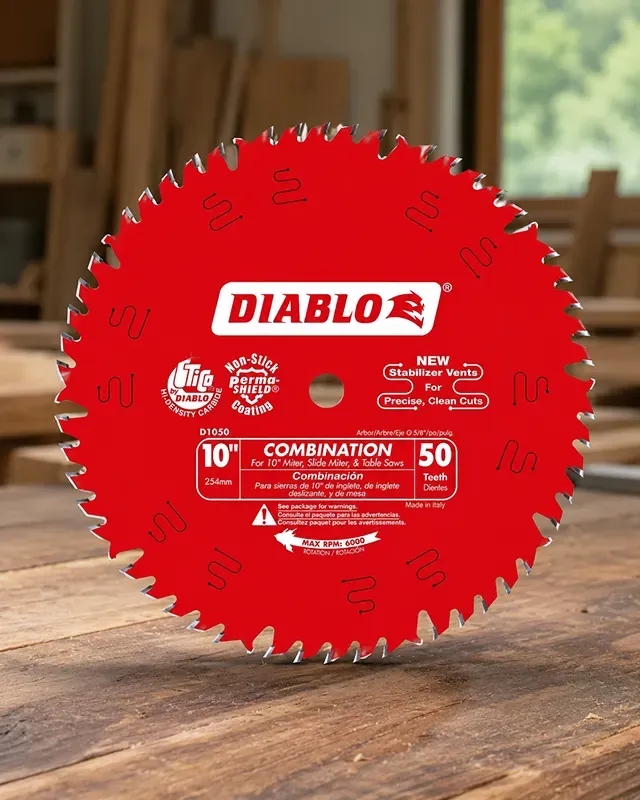
Stock blades on many portable saws are usually general-purpose construction blades, so users often upgrade when they want cleaner plywood, hardwood, or furniture-grade cuts. For garage woodworkers and jobsite carpenters looking for a better table saw blade, the Diablo D1050X 10 inch 50 tooth combination blade is one of the most common first upgrades.
Manufactured by Freud, the D1050X is designed to bridge the gap between ripping (cutting with the grain) and crosscutting (cutting across the grain) without forcing the user to change blades for every operation. For broader blade selection by cut type, see our guide to table saw blades by cut type.
However, relying on a single blade involves mechanical compromises. Based on its tooth geometry, plate thickness, and long-term ownership feedback, here is how the D1050X is designed to behave - and where its limitations tend to show up in the shop.
Combination Blade Mechanics
To understand the table saw blade tooth count on the D1050X, it helps to look at dedicated blades first. A dedicated rip blade usually has 24 teeth and massive gullets (the valleys between the teeth) to clear out the long, stringy chips generated when cutting with the grain. A dedicated crosscut blade usually has 60 to 80 teeth to shear delicate fibers and minimize tearout, but it will bog down quickly if used for ripping because its tiny gullets cannot clear sawdust fast enough.
The Diablo D1050X utilizes a 50-tooth combination configuration. The teeth are grouped together with deep gullets separating the groups. For another 50T grouped-tooth example, see our CMT combination blade review.
This specific geometry strikes a mechanical middle ground. The deep gullets provide the necessary air volume to evacuate sawdust during long rip cuts, while the closely grouped teeth reduce the “bite size” per tooth, allowing the blade to crosscut plywood and dimension lumber with minimal tearout.
Kerf Thickness and Motor Load
The most critical specification on the D1050X for a portable table saw is its 0.098-inch kerf.
A standard industrial table saw blade has a full 1/8-inch (0.125-inch) kerf. Pushing a 1/8-inch blade through thick stock requires significant torque, which is why cabinet saws use 3-horsepower induction motors. Jobsite saws, however, usually rely on 15-amp universal motors with much less torque reserve than a 3HP cabinet saw.
Because the D1050X cuts a thin kerf slot that is roughly 20% narrower than a full-kerf blade, it removes less wood. This mechanically reduces the rotational resistance on the arbor. Owner feedback commonly points to easier feed and less strain on lower-powered saws, especially compared with thicker or dull stock blades.
Safety Note: Riving Knife Alignment
The 0.098-inch kerf introduces a strict safety constraint. To prevent kickback, your table saw’s riving knife must be thinner than the blade’s kerf but thicker than the blade’s steel plate (0.071 inches). Many modern portable saws use riving knives around this range, but the correct check is always your saw manual and an actual thickness measurement. Running a 0.098-inch blade with a 0.100-inch or thicker splitter can cause the workpiece to bind against the splitter during the cut. Always verify your riving knife thickness before installing any thin-kerf blade.
The Tradeoffs: Deflection and Joinery Limits
While the D1050X excels as a primary mixed-use blade, it has two distinct mechanical limitations that surface during precision woodworking.
1. Plate Deflection
To achieve a 0.098-inch kerf, the steel plate of the D1050X is milled down to just 0.071 inches. Under heavy lateral loads—such as ripping dense, twisted 8/4 hardwood or feeding material slightly offline from the fence—this thin plate can flutter. While Diablo mitigates this with laser-cut, polymer-filled stabilizer vents to reduce vibration, all else equal, a thinner plate has less lateral stiffness than a heavier full-kerf industrial plate. Pushing the D1050X too hard can increase the chance of visible saw marks if feed pressure, fence alignment, or stock stress is poor.
2. Joinery and Non-Through Cuts
Many woodworkers assume a combination blade will leave a perfectly flat bottom for cutting non-through joinery, such as splines or tenons.
The blade’s combination geometry and ATB-style cutting edges are not designed to leave a flat-bottom groove. The alternating teeth physically score deeper into the outside edges of the cut than the center. As a result, if you cut a 1/4-inch deep groove, the bottom of that groove will have small, V-shaped scoring lines (often called “bat ears”) at the outer corners. For perfectly flat-bottomed trenches, you need a dedicated Flat Top Grind (FTG) rip blade or a dado stack.
Owner Feedback Synthesis
Retailer reviews and public woodworking discussions generally align with the blade’s mechanical design:
- Recurring Strengths: Users commonly praise the blade for cleaner cuts than stock blades, good value, and smooth mixed ripping/crosscutting. Many owners treat it as a default blade that can stay on a jobsite saw for most mixed-use cutting.
- Recurring Limitations: The limitations are predictable based on the geometry. It is not a dedicated heavy-rip blade, it is not a flat-bottom joinery blade, and it can burn in thick hardwood if feed rate, blade cleanliness, or saw power are not matched.
Maintenance and Coating
The blade features Diablo’s red Perma-Shield coating, intended to reduce heat, pitch buildup, and corrosion. While the coating does reduce friction, it is not immune to pine resin. Long-term owner feedback often treats pitch buildup as one of the first things to check when the blade begins to burn wood or feel dull. Soaking the blade in a dedicated resin cleaner or simple green often restores its original cutting performance without the need for sharpening.
For a deeper maintenance breakdown, see our guide to table saw blade cleaning and resin buildup.
Who Should Consider the D1050X?
- Jobsite and Garage Woodworkers: If you operate a 15-amp portable saw (like a DeWalt, Bosch, or Skil), this blade’s thin kerf helps make better use of the limited torque available on many portable saws.
- Mixed-Material Users: If your workflow shifts constantly between ripping 2x4s and crosscutting plywood, the 50-tooth geometry saves the friction of constant blade changes.
- Budget-Conscious Upgraders: It offers an immediate, noticeable leap in cut quality over stock general-purpose blades at a practical price point.
Who Should Skip It?
- Heavy Hardwood Processors: If you primarily rip thick, dense hardwoods (like maple or white oak) on a 3HP cabinet saw, a heavy full-kerf 24T rip blade will resist deflection and leave a cleaner edge.
- Joinery Purists: If you plan to use your main blade to cut box joints, splines, or flat-bottomed dadoes, the ATB geometry on the D1050X will leave undesirable scoring marks at the bottom of the cut.
If you want a more traditional 50T combination blade comparison point, see our Freud LU83R010 review.