
DeWalt DWE7491RS Review: Fence Design, Cut Capacity, and Tradeoffs
INFO
Evidence Level: Level 1 — Document Lab + Owner Feedback Review
Evidence note: This review is based on DeWalt documentation, published specifications, manual-supported accessory limits, public owner feedback, and mechanical analysis. WoodGearLab has not physically measured this specific saw for runout, fence deflection, table flatness, or cut quality.
Verdict: The DWE7491RS makes the most sense when mobility, wide rip capacity, and a low-friction fence matter more than cast-iron mass, quiet operation, and cabinet-saw flatness. It is not a replacement for a stationary saw in a dedicated furniture shop, but it is one of the more mechanically capable jobsite-format saws for garage users who need the saw to fold away.
Mechanical Tradeoffs at a Glance
| Feature | What it helps | Tradeoff |
|---|---|---|
| Rack-and-pinion fence | Faster repeatable rip-width changes | Still needs initial alignment checks |
| 32-1/2 inch rip capacity | Wider sheet-good cuts | Short table still needs outfeed support |
| Rolling stand | Garage storage and jobsite mobility | Less mass than stationary saws |
| 10-inch blade | More blade/accessory compatibility | Larger blade load than compact 8-1/4 inch saws |
| Dado support | Rabbets, grooves, box-joint work | Requires correct dado insert and guard/riving-knife changes |
| 2-port dust setup | Better than lower-port-only collection | Still limited by open jobsite saw geometry |
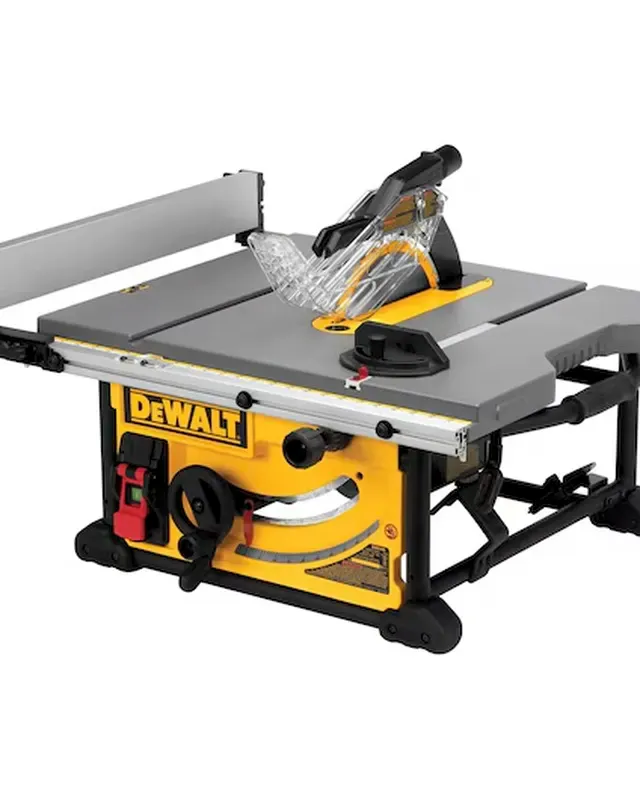
The DeWalt DWE7491RS occupies a specific space in the table saw market. It is technically a portable jobsite saw, but its extended rip capacity and rolling stand have made it a frequent fixture in small garage workshops.
For woodworkers dealing with tight spaces, the appeal of a saw that can cut wide sheet goods and then fold up against a wall is obvious. However, relying on a jobsite saw for furniture or cabinet making introduces structural tradeoffs. Understanding what this saw is built to do—and where its physical limits lie—is critical before fitting it into a shop workflow.
The Rack-and-Pinion Fence System
The most significant mechanical advantage of the DWE7491RS is its fence. Most entry-level and portable table saws use a T-square style fence that clamps only at the front rail. On lightweight aluminum rails, these friction-clamp fences are prone to skewing as you lock them down, requiring constant measuring to ensure the fence is parallel to the blade.
DeWalt’s rack-and-pinion system addresses this by linking the front and rear fence rails with a geared shaft. When you turn the adjustment knob, gears engage tracks on both the front and back simultaneously. Owner feedback consistently treats the rack-and-pinion fence as one of the saw’s strongest usability advantages, because it reduces the need to re-measure after every fence movement.
Mechanically, it is designed to move the front and rear of the fence together, which helps preserve parallelism better than many front-clamping portable fences. While it does not eliminate the need to perform initial blade alignment during setup, this design largely mitigates traditional table saw fence accuracy issues on a mobile platform.
32-1/2 Inch Rip Capacity vs. Table Depth
The DWE7491RS lists a 32-1/2 inch maximum rip capacity to the right of the blade. That number matters because it places the saw closer to sheet-good work than many compact jobsite saws, allowing users to rip the center of a full 4x8 sheet of plywood.
However, rip capacity is not the same thing as table support. The saw’s table measures approximately 21-7/8 inches deep from front to back. When pushing a large sheet of plywood through a table of this depth, the material has very little surface area to rest on before it reaches the blade, and it will quickly tip off the back of the saw after the cut.
Without a secondary outfeed table or support stands, breaking down heavy sheet goods on a lightweight jobsite saw remains a balancing act. When determining your table saw size requirements, remember that a wide fence rail does not compensate for a short table depth.
10-Inch Blade and Dado Compatibility
The table saw market has recently seen a shift toward 8-1/4 inch blades in the portable category. The DWE7491RS is an older design that retains a 10-inch blade and a full-length 5/8-inch arbor.
Because of this arbor length, the manual confirms the DWE7491RS has dado blade compatibility for an 8-inch dado stack up to 13/16 of an inch wide. For woodworkers wanting to cut box joints or grooved cabinet parts, this is a major factor.
The 15-amp universal motor is compatible with an approved dado stack within the manual’s limits, but dado cuts increase load. In practice, users should take shallow passes and feed more slowly than they would on a heavier 3 HP cabinet saw, and use extreme care since a dado is a non-through cut requiring the removal of the blade guard and riving knife. Because dado work removes the normal guard/riving-knife configuration, this should be treated as a controlled setup operation, not a casual accessory swap.
The Rolling Stand and Shop Mobility
The included rolling stand operates on a gravity-rise mechanism. You can collapse the legs and stand the entire saw vertically on its wheels. For a garage shop where a car needs to be parked at night, this vertical footprint is incredibly efficient.
The tradeoff comes in the form of vibration and mass. The DWE7491RS weighs roughly 90 pounds with the stand included. The top is made of cast aluminum, not the heavy cast iron found on stationary saws. Because the machine lacks the dampening mass of cast iron, the vibration from the universal motor transfers more noticeably into the table and the workpiece. If you are weighing the benefits of jobsite vs contractor table saws, the mobility of the rolling stand is the exact feature you trade for the dampening mass and stability of a heavier belt-driven saw.
Dust Collection Realities
Table saw dust collection on portable units is notoriously difficult because the internal cabinet geometry is relatively open. The DWE7491RS features a standard 2-1/2 inch dust port at the lower rear of the saw, as well as a secondary port built into the overhead blade guard.
Owner feedback frequently notes that connecting a standard shop vacuum to the rear port alone captures only a portion of the dust. To maximize collection, owners typically have to build or purchase a Y-adapter hose to draw suction from both the top guard and the lower cabinet simultaneously. Even with this setup, expectations should be kept realistic for a jobsite saw.
Table Flatness and Tolerances
A recurring theme in community discussions regarding this saw is the flatness of the cast aluminum table. Some users report measuring minor dips or crowns in the table top and question if the saw is defective.
Cast-aluminum tops are generally less massive and less heavily machined than cabinet-saw cast iron tops. Minor variation is not unusual on cast-aluminum jobsite saw tops, but without a published flatness tolerance from DeWalt, it is better to treat each saw as an individual setup check rather than assume cabinet-saw flatness. This slight deviation is rarely an issue for ripping framing lumber or sizing plywood, but limitations may appear in highly precise, gap-free fine furniture work.
Who This Saw Makes Sense For
The DWE7491RS makes sense for the mobile contractor, the serious DIYer, and the space-constrained garage woodworker. It has the published capacity and motor class expected for hardwood ripping in a jobsite format, but feed rate, blade choice, and stock thickness still matter. It offers support for dado stacks, and a fence system that reduces repeated measuring compared with many front-clamping portable fences. If you need a saw that can be tucked into a corner at the end of the day, it is a highly capable choice.
Availability and package contents can vary by retailer, so confirm the included stand, blade, guard assembly, and dado insert requirements before buying.
Who Should Skip It
If you have a dedicated workshop with permanent floor space, you should strongly consider whether the portable category is the right compromise. A stationary saw will provide a heavy cast iron top, a deeper table for better material support, a quieter belt-driven induction motor, and significantly better vibration dampening.
For first-time buyers, this is exactly the kind of tradeoff that should be decided by workflow, storage space, and project type rather than brand name alone.
What WoodGearLab Would Measure Next
If we were to test this saw in our lab, our mechanical verification would focus on:
- Fence deflection under side load at several rip widths.
- Blade-to-miter-slot alignment before and after transport.
- Fence repeatability after repeated rail adjustments.
- Table flatness across the main casting and extension wings.
- Dust capture difference between lower-port-only setup and dual-port setup.
- Noise/vibration comparison against a belt-driven contractor or hybrid saw.