
Delta 36-725T2 Review: Contractor Saw Design, Fence, and Shop Use
INFO
Evidence Level: Level 1 — Document Lab + owner-feedback synthesis.
This review is based on Delta documentation, published specifications, manual analysis, public teardown/troubleshooting discussions, and long-term owner feedback. WoodGearLab has not physically tested this saw.
For many woodworkers, the transition out of the jobsite table saw category is driven by three distinct frustrations: vibration, limited table depth in front of the blade, and fences that require constant double-checking.
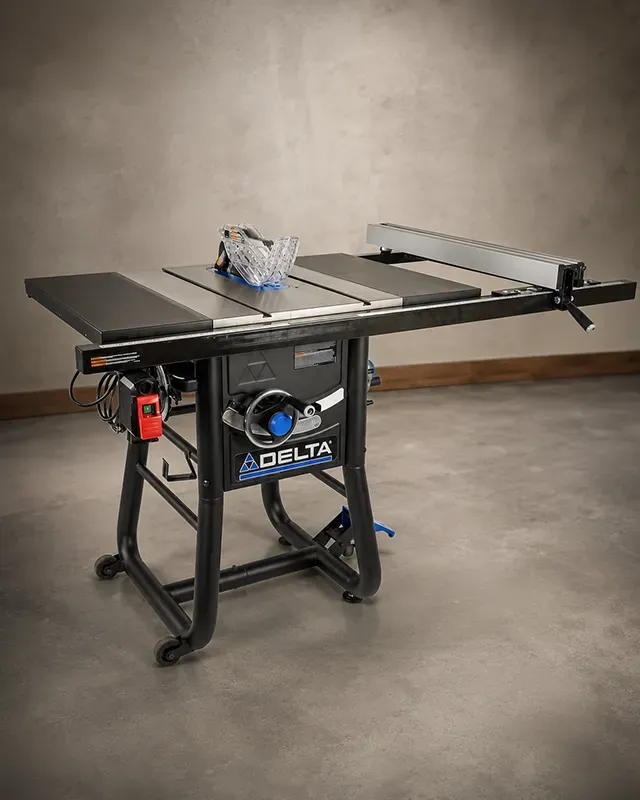
The Delta 36-725T2 sits directly on that upgrade path. As a 10-inch, 15-amp contractor saw, it is designed to bridge the gap between portable jobsite models and heavier, more expensive cabinet saws. It offers cast iron mass, a belt-driven motor, and a highly regarded fence system, all priced for the serious hobbyist or small garage shop.
But moving to a stationary saw introduces new mechanical tradeoffs. Based on manufacturer documentation, design geometry, and long-term ownership feedback, here is a breakdown of how the Delta 36-725T2 is built, where it holds a mechanical advantage, and the specific limitations you should understand before bringing it into your shop.
The Cast Iron Core and Stamped Wings
The most noticeable mechanical upgrade from a jobsite saw is the table itself. The Delta 36-725T2 features a 27 by 20 inch cast iron center table.
The extra mass and stiffness help damp some vibration that would otherwise be transmitted through a lighter aluminum table. The physical mass absorbs much of the operating energy, and the deeper table provides more registration surface to stabilize sheet goods or longer boards before they meet the blade.
However, to keep the overall weight down to its listed 195 pounds, Delta uses stamped steel extension wings on the left and right, rather than solid cast iron.
Mechanically, stamped steel does not hold its shape as rigidly as cast iron. Long-term owner reports often mention that leveling these wings to be perfectly flush with the center table is a tedious, frustrating process. It frequently involves tightening bolts in a specific sequence or using tape shims to pull a subtle bow out of the steel. Once set, they hold adequately, but expect the initial setup to require patience.
The T-Square Locking Rip Fence
The strongest structural argument for this saw is its fence. The 36-725T2 uses a T-square 3-point locking rip fence system.
Many cheaper saws use fences that clamp at both the front and the rear of the table. If the clamping mechanism pulls unevenly, the rear of the fence can shift slightly into the blade, creating a pinch point that risks kickback, affecting overall fence accuracy.
A T-square fence works differently. It rides entirely on a heavy front guide tube. When you press the locking lever, a cam mechanism clamps the fence rigidly to that front tube. The back of the fence simply rests on the rear rail on a nylon glide pad—it does not clamp to it.
When properly adjusted, the front-locking layout helps keep the fence square to the blade path. It allows you to nudge the fence into position with one hand and lock it down with confidence. For anyone struggling with alignment on an entry-level saw, this mechanism alone represents a major workflow improvement.
Motor Design and Reliability Concerns
The Delta 36-725T2 utilizes a 15-amp, 120V enclosed induction motor.
Unlike the high-pitched universal motors found in many portable saws, this induction motor is belt-driven. This physical separation between the motor and the arbor alters the acoustic profile of the machine; when you power it on, it hums rather than whines. It also supports a maximum dado width of 13/16 inches when set up according to the manual, which matters for dados, rabbets, and other joinery cuts.
However, we cannot review this saw without addressing its most well-documented issue. Across woodworking forums and troubleshooting communities, a notable pattern of owner reports regarding motor and starting issues has emerged with the T2 iteration.
The number of public reports is high enough that this should be treated as a purchase-risk factor, not as a guaranteed failure. Public troubleshooting threads often discuss the start capacitor, centrifugal switch, and control components, but WoodGearLab has not physically diagnosed a failed T2 motor.
It is worth noting that the manufacturer manual explicitly warns against voltage drops. Running a 15-amp induction motor on a long, undersized extension cord can cause a loss of power, overheating, and potential damage to the machine’s electrical components. If you purchase this saw, plugging it directly into a suitable 120V circuit and avoiding long, undersized extension cords is a sensible mechanical precaution.
Trunnions and Alignment
Typical for this class of machine, the trunnions—the heavy cast assemblies that support the motor, arbor, and blade-tilting mechanism—are bolted directly to the underside of the cast iron table.
This matters when you need to align the blade parallel to the miter slots. Unlike cabinet-mounted designs where you can easily loosen the table top and tap it into alignment, a table-mounted trunnion requires you to loosen the bolts underneath the table and shift the heavy mechanical assembly itself.
It is awkward work that requires reaching into the saw’s cabinet. Fortunately, because the cast iron table provides a rigid mounting surface, once aligned, this type of setup should be relatively stable unless the saw is moved aggressively, dropped, or subjected to a hard impact.
Dust Collection and Mobility
Jobsite saws are notoriously difficult to extract dust from because the bottoms are often completely open. Full cabinet saws enclose the entire lower half. The Delta 36-725T2 splits the difference.
It features a fabric shroud beneath the blade that funnels dust to a 2.5-inch port. Mechanically, this arrangement should capture more heavy sawdust than an open-bottom jobsite saw when connected to a shop vacuum, but it should not be confused with a sealed cabinet-saw dust collection system. Because the cabinet is not completely sealed—it requires openings for the trunnions and belt to articulate—fine dust will still escape into the air.
Where the Delta has a clear practical advantage for garage shops is mobility. The included tubular steel stand features a single-step caster pedal. Pressing the pedal lifts the entire 195-pound saw onto a swiveling wheel, allowing you to easily pivot and roll the machine out of the way. When building a garage setup where a car still needs to park, this built-in mobility system is highly effective.
Who This Saw Makes Sense For
The Delta 36-725T2 provides a highly capable blueprint for a specific type of woodworker:
- Users upgrading from a jobsite table saw who want the vibration dampening of cast iron and the precision of a T-square fence.
- Woodworkers operating out of a shared space who require a highly maneuverable, built-in mobile base.
- Those who want the lower-noise character and vibration advantages typically associated with a belt-driven induction motor, while staying on standard 120V power.
Who Should Skip It
- Production shops: The stamped steel wings and 15-amp, 120V motor are not designed for constant, heavy ripping of dense hardwoods day in and day out.
- Users relying on long extension cords: Given the manufacturer warnings regarding voltage drop and the community reports of electrical component failure, running this saw on compromised electrical circuits is an unnecessary risk.
- Those deciding on a larger machine: If you are still deciding what size table saw you need, this saw sits in the middle ground between portable jobsite saws and full cabinet saws. If you have the budget and the 220V power available for a true cabinet saw with cabinet-mounted trunnions and solid cast-iron wings, the long-term setup friction will be significantly lower.
The Delta 36-725T2 offers a strong structural blueprint and a very capable fence system. If you understand its setup quirks and respect its electrical requirements, it can serve as a serious anchor for a developing garage shop.