
Bosch 4100XC-10 Review: Gravity-Rise Stand, Fence, and Jobsite Use
INFO
Evidence Level: Document Analysis, Specifications, and Recurring Owner-Feedback Patterns
The Bosch 4100 series has been a staple on jobsites for years, largely because Bosch recognized a fundamental truth: a jobsite table saw is useless if you avoid moving it because it is too heavy or awkward.
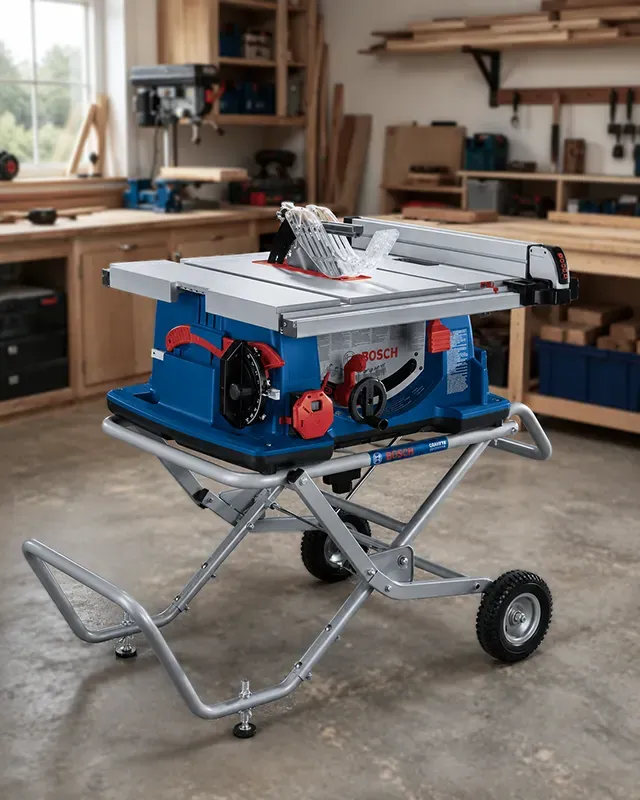
The Bosch 4100XC-10 is the current iteration of this platform. It pairs a 15-amp motor and a 30-inch right rip capacity with the widely recognized GTA47W Gravity-Rise stand. Based on technical documentation, published specifications, mechanical analysis, and recurring owner-feedback patterns, this saw prioritizes worksite setup and structural mobility above all else.
But prioritizing jobsite durability and transport means accepting specific compromises, particularly regarding dust collection and fence mechanics.
Motor and Electronics
Under the cast aluminum table, the Bosch 4100XC-10 runs a 15-amp brushed motor spinning a 10-inch blade at 3,650 RPM. Bosch rates it at up to 4.0 max horsepower, though in standard 120V workshop environments, the electronic management systems are more practical to understand than peak horsepower ratings.
The saw includes built-in soft-start circuitry. Mechanically, soft-start circuitry manages motor startup intensity, which helps reduce the chance of nuisance breaker trips during startup. This is especially valuable on jobsites where extension cords and shared 15-amp circuits are common.
Additionally, the saw features Constant Response circuitry, which Bosch describes as helping maintain blade speed under load. In practical terms, this is an electronic speed-control feature, not a substitute for a stronger motor or a slower feed rate. It is designed to help reduce speed loss when the blade encounters heavier load, but feed rate, blade sharpness, material moisture, and circuit quality still matter.
The Gravity-Rise Stand Advantage
The defining feature of the 4100XC-10 is the included GTA47W Gravity-Rise stand. For contractors or garage woodworkers who need to collapse and store their saw against a wall at the end of every day, this stand dictates the entire ownership experience.
The mechanical design uses leverage and the weight of the saw itself to assist in raising and lowering the table. You are not repeatedly lifting the full saw-and-stand package by hand; you are guiding the stand geometry through its folding path.
Once folded, the stand rolls on 8-inch rubber-composite treaded tires. Unlike small, hard plastic casters that bog down in gravel, mud, or extension cords, these wheels provide real jobsite saw mobility. If you move your saw daily, this stand is the main reason to put the Bosch on the shortlist.
The SquareLock Fence Tradeoff
Bosch equips this saw with what they call the SquareLock rip fence. It glides along aluminum rails and clamps at the front and rear of the table.
When locked, the SquareLock fence is generally a credible jobsite fence. The tradeoff appears during adjustment. Because it is not a rack-and-pinion fence system, the operator has more responsibility to slide, align, and lock the fence consistently. For framing, renovation work, and general shop cuts, this is usually acceptable. For repeat fine furniture cuts, a geared fence system creates less setup friction.
If you are accustomed to checking fence alignment before critical cuts, the Bosch fence is capable. If you expect automated table saw fence accuracy every time you slide the fence, you will need to adjust your workflow.
Dust Collection and Portability Constraints
Portability often works against dust collection, and the 4100XC-10 is no exception.
Owner feedback on portable jobsite saws commonly treats dust collection as a compromise, and the 4100XC-10’s open underside and folding stand geometry make full containment unrealistic. Even with a shop vacuum attached to the rear dust port, sawdust can still escape through the bottom and sides of the saw body.
This is not a failure of the dust port alone; it is a geometry problem created by an open, portable saw body. If you cut outdoors or on a rough framing site, this is largely irrelevant. If you cut indoors in a finished garage or basement shop, you should expect extra cleanup and manage your expectations regarding table saw dust collection accordingly.
The Competition: DeWalt and Skil
When evaluating the 4100XC-10, it helps to understand how its specific tradeoffs compare to its primary rivals:
DeWalt DWE7491RS
The DeWalt DWE7491RS is often considered the benchmark for portable fence accuracy due to its rack-and-pinion design. DeWalt’s stronger argument is fence behavior and larger rip capacity (32-1/2 inches), not necessarily overall mobility. Its rolling stand is capable, but Bosch’s Gravity-Rise system has the clearer mobility-first identity.
Skil TS6307-00
The Skil TS6307-00 is the lighter, lower-cost, integrated-leg alternative. It gives you rack-and-pinion adjustment, but it does not offer the same wheeled cart-style transport system or 30-inch rip capacity as the Bosch. It is better suited for occasional transport rather than daily jobsite rolling.
Who Should Consider It
The Bosch 4100XC-10 is not the obvious choice because it has the most modern fence system. It is the obvious choice when moving, folding, storing, and redeploying the saw are part of the work. If you prioritize rolling the tool across uneven ground and getting it set up quickly with less lifting effort, the GTA47W stand is the main reason this saw remains a practical choice.
Who Should Skip It
If you are a fine furniture maker working in a small basement shop where portable table saw setup is a one-time event and the saw rarely moves, the Gravity-Rise stand adds bulk you do not need. In those cases, a saw with a geared fence and a more enclosed cabinet will provide a less frustrating daily workflow.