
Jobsite vs Contractor Table Saw: What Actually Changes in Real Use
NOTE
Research Notes
Evidence Level: Level 0 — Theory Lab + Level 1 — Document Lab This article compares jobsite and contractor table saws using mechanical principles, manufacturer specifications, and manual-level design information. It does not include WoodGearLab physical testing or measured vibration, noise, or cut-quality data.
Sources Consulted:
- Manufacturer specifications and manuals (SawStop, DeWalt, Delta, Bosch)
- Independent long-term utility reports
- Woodworking forum logs regarding alignment and maintenance
- Mechanical comparisons of motor and trunnion types
Observed Patterns:
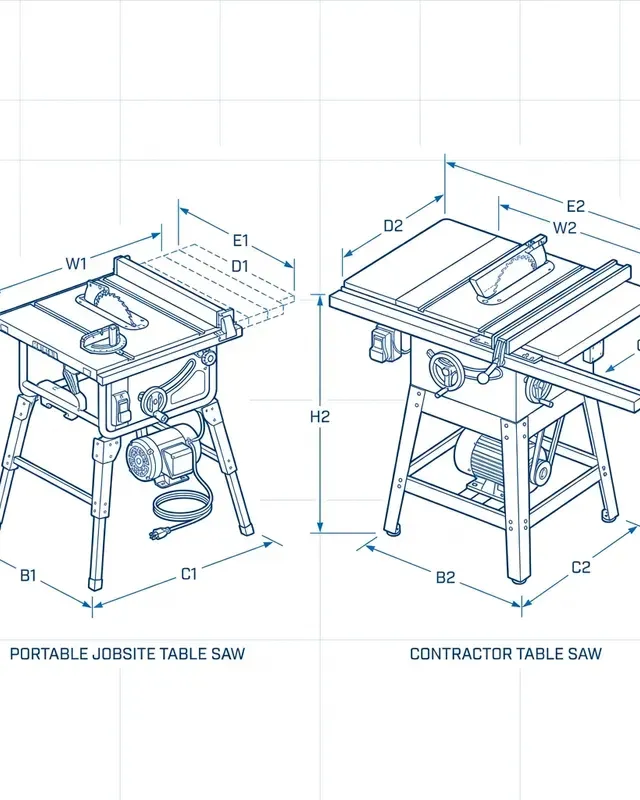
- Jobsite Saws: Consistently built around portability. Strengths include compact 15A motor packages, lightweight cast aluminum tables, and smart parallel fence systems such as rack-and-pinion rails. Common limitations involve noise profile and a lower threshold for structural flex under heavy load.
- Contractor Saws: Traditional contractor saws are built around mass and stability. Strengths include induction motors, cast iron tables, and robust trunnions. Limitations center heavily on weight, footprint, and open-base dust collection challenges.
Points of Disagreement: There is significant debate online about whether embedding a jobsite saw into a custom workbench bridges the gap between categories. Mechanically, a bench improves outfeed support but cannot alter the internal motor architecture, fence rail baseline, or arbor rigidity.
Confidence: High
CAUTION
Important category note: “Contractor saw” is not a perfectly consistent modern category. Traditionally, it meant an open-stand, belt-driven saw with an induction motor and a cast-iron table. Today, some manufacturers use the term more loosely for hybrid or lighter shop saws with foldable stands. In this article, “contractor saw” refers to the traditional shop-oriented format: heavier table, induction motor, belt drive, and a more rigid base than a portable jobsite saw.
For a woodworker setting up a shop, choosing between a jobsite and a contractor table saw dictates the core mechanics of how the saw cuts, how it responds to heavy material, and how easily the saw can support repeatable setup over time.
| Feature | Jobsite Table Saw | Contractor Table Saw |
|---|---|---|
| Primary design goal | Portability and jobsite setup | Stationary shop use and stability |
| Common motor type | 15A universal motor | 1.5–1.75 HP induction motor |
| Drive layout | Direct-drive or compact geared layout | Belt-drive layout |
| Table material | Cast aluminum or coated/stamped metal | Cast iron main table, often with wings |
| Typical weight range | About 45–110 lb | About 200–300+ lb |
| Fence style | Compact rail system, often rack-and-pinion | Larger T-square or front-rail fence |
| Best use case | Mobile work, remodeling, garage storage | Repeatable shop work, larger stock, jigs |
Motor Design: Universal vs. Induction
The most significant functional difference between these two platforms sits beneath the table surface.
The Jobsite Motor (Universal)
Most jobsite table saws use compact universal motors. These motors are incredibly power-dense, allowing them to deliver strong cutting capability relative to their small size and light weight. However, they typically run at higher internal speeds than induction motors.
This high-speed, brush-driven design contributes to two main real-world consequences:
- Acoustic Profile: Universal motors produce a sharper, higher-pitched sound profile. While hearing protection is required for all table saws, a jobsite motor’s whine is generally more fatiguing in an enclosed garage over long periods.
- Torque Behavior: When a universal motor encounters dense hardwood or a thick knot, it tends to lose RPMs faster than a belt-driven induction motor. Pushing too hard against this resistance can slow the blade, increase heat, and make the cut less controlled, especially if the board is poorly supported or the fence and blade alignment is marginal.
The Contractor Motor (Induction)
Traditional contractor table saws use induction motors. These motors lack carbon brushes, rely on magnetic fields to rotate, and generally drive the arbor via a V-belt or poly-V belt.
The mechanical advantages are distinct:
- Load Handling: A larger induction motor and belt-drive layout is generally better suited to sustained cutting load, especially in thick hardwood, because the motor and pulley system are not optimized primarily for minimum weight. They maintain blade speed more predictably in heavier cuts.
- Smoother Operation: Without brushes scraping an armature at high speeds, an induction motor produces a smoother, lower-pitched hum.
Structural Mass and Vibration Dampening
Excess vibration can make clean, repeatable cutting harder because the blade, arbor, table, and workpiece are less mechanically settled during the cut. In practice, this can contribute to rougher cut edges, more setup sensitivity, or more sanding after the cut.
Jobsite table saws prioritize low weight so a single user can lift the unit. To achieve this, manufacturers use cast aluminum tables, stamped steel parts, and plastic housings. While highly portable, this lack of mass limits the saw’s ability to absorb the kinetic energy of a spinning blade or an uneven board.
Contractor saws prioritize mass. They feature heavy, precision-ground cast iron table tops. This heavy cast iron acts as a giant energy sink, dampening motor vibrations and providing a flatter, heavier reference surface with more resistance to movement. A 250-pound saw is much less likely to shift during normal feed pressure than a lightweight portable saw, assuming it is on a level floor and the stand is properly locked.
The Underside: Trunnion Assembly and Alignment
The trunnions are the brackets that secure the motor and arbor assembly to the saw. They control height, bevel tilt, and blade parallelism to the miter slots.
The lighter trunnion and motor-support structure in a jobsite saw gives manufacturers a weight advantage, but it also leaves less structural margin than a heavier cast-iron assembly. That does not mean every jobsite saw is inaccurate; it means the platform is less forgiving when pushing heavy, twisted, or poorly supported stock.
On a traditional contractor saw, the trunnion assembly relies on larger, heavier cast-iron components. A heavier contractor-style trunnion system is mechanically better suited to holding calibration, assuming the saw is assembled correctly, not moved frequently, and periodically checked.
Fences, Slots, and Shop Jigs
A table saw’s utility relies heavily on how well it supports the wood and the jigs you use to push it.
Fence Rigidity
Many premium jobsite saws utilize a rack-and-pinion fence system. This design is exceptional for keeping the fence parallel to the blade during adjustments. However, the fence body itself is often lightweight to save on portability.
Contractor saws generally ship with substantial T-square style fences that lock onto a thick steel tube. A heavier T-square-style fence generally gives more resistance to side pressure than the compact fences used on many portable saws. Because the fence body is made of heavier steel and clamps rigidly at the front, it maintains a straighter reference line against lateral force.
Miter Slots and Sleds
Jobsite saws frequently have shallow miter slots or use retaining tabs designed to keep proprietary, lightweight miter gauges from falling out. This can complicate building high-precision, heavy crosscut sleds. Many contractor saws use full-size 3/4-inch miter slots machined into the cast iron table, often with T-slot profiles depending on the model, allowing woodworkers to build heavy shop sleds that glide smoothly.
Dust Collection Realities
Dust management is a persistent challenge for any table saw.
Jobsite saws usually feature tight internal shrouds around the blade, funneling dust to a small 2.5-inch port designed for a shop vacuum. While this catches fine dust reasonably well, coarser chips often spill out through the open bottom or through the motor vents.
Traditional contractor saws with open stands and rear-hanging motors are historically difficult to seal for dust collection. However, many modern stationary shop saws—often labeled as hybrid or enclosed contractor saws—feature enclosed lower cabinets. These designs are vastly superior for hooking up a proper 4-inch dust collection system to pull high volumes of air and chips down and away from the operator.
The Workbench Upgrade Is Real, But Limited
A common strategy in the woodworking community is to buy a jobsite saw and build a massive, custom workbench around it to simulate a larger shop saw. It is important to understand the mechanical realities of this approach.
What the workbench fixes:
- Outfeed and Side Support: It provides a massive, stable surface to catch large panels, drastically reducing the risk of a board tipping and causing kickback.
- Storage and Height: It allows you to customize the working height and add dust collection routing.
What the workbench cannot fix:
- Motor Torque: The 15A universal motor will still respond the same way to dense hardwood.
- Arbor and Trunnion Rigidity: The internal structural margin beneath the table remains unchanged.
- Fence Deflection: Unless you install an aftermarket T-square fence onto the workbench itself, you are still relying on the jobsite saw’s factory fence rails.
Making the Decision
Neither platform is universally superior; they are engineered to solve different primary constraints.
Choose a Jobsite Table Saw If…
- You need to fold the tool up and store it tightly against a wall after every session.
- You need to transport the saw in a vehicle to different locations.
- You are working in a shared, multi-use garage where a permanent tool footprint is impossible.
- You primarily cut plywood, framing lumber, trim, and smaller home projects rather than thick hardwoods.
Choose a Contractor Table Saw If…
- You have a dedicated, permanent space for the tool in your shop layout.
- You plan to use crosscut sleds, tenoning jigs, and other standard 3/4-inch miter accessories frequently.
- You cut thicker hardwoods and want the blade speed to remain consistent under load.
- You want a flatter, heavier cast iron reference surface for maximum stability.
- You prefer the smoother, lower-pitched hum of an induction motor.
Avoid a Jobsite Saw If…
- You intend to turn it into a high-precision cabinet saw merely by dropping it into a workbench. The bench helps tremendously with support, but it does not change the internal mechanics.
Avoid a Contractor Saw If…
- You have to move your tools over thresholds, grass, or up into truck beds regularly.
- You do not have the space for a proper dust collection layout, as open-stand contractor saws are notoriously difficult to seal perfectly for a simple shop vacuum.
A jobsite table saw is not a worse saw. It is a portable saw with mechanical compromises. A contractor table saw is not automatically more accurate. It simply gives the user more mass, support surface, motor smoothness, and calibration margin. The right choice depends less on brand and more on whether your shop needs mobility, storage efficiency, or mechanical stability.