
Jobsite Table Saw Models Compared by Fence, Stand & Safety
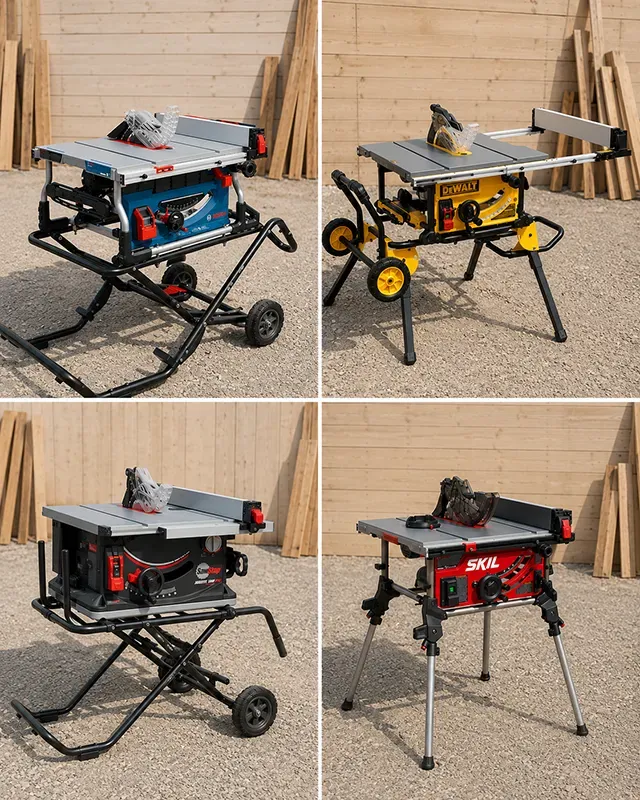
INFO
Evidence Level: Level 1 — Document Lab + owner-feedback synthesis.
This comparison is based on manufacturer specifications, manuals, independent review observations, and long-term owner feedback. WoodGearLab has not physically tested these saws.
Jobsite table saws are designed around a single overriding constraint: portability. To make a saw light enough for one person to move, manufacturers use aluminum tables instead of cast iron, and direct-drive universal motors instead of heavier, belt-driven induction motors.
If you are setting up a permanent workshop with a dedicated 220V circuit, a jobsite saw is a compromise. But if you lack space, work out of a garage that needs to park cars at night, or actually need to move the tool between locations, a jobsite saw is often the only practical choice.
The difference between a frustrating jobsite saw and a reliable one comes down to three things: how the fence locks, how the stand handles weight, and what safety mechanisms are in place. Based on available documentation and long-term owner feedback, here is how several widely discussed jobsite table saw models compare mechanically.
Before comparing individual models, it helps to separate compact carry-style table saws from larger rolling-stand jobsite saws. Both are portable, but they differ in blade diameter, table depth, stand stability, usable arbor length, and dado compatibility. For the category-level breakdown, see our guide to compact vs jobsite table saws.
The Fence Problem: Clamping vs. Gearing
A table saw is only as useful as its fence. If the fence is not perfectly parallel to the blade, the wood can pinch against the back teeth, causing burning or severe table saw kickback.
Most entry-level and traditional jobsite saws use a T-square or clamp-style fence. When you lock the handle at the front, it clamps onto the front rail. Traditional clamp-style and T-square fences rely more on the rail, lock mechanism, and user verification than a geared rack-and-pinion system. The Bosch 4100XC-10 uses a SquareLock fence designed to self-align and lock from the front, but it still belongs to a different mechanical family than DeWalt’s geared fence adjustment. In practice, critical cuts should still be verified against the miter slot or blade, especially after transport.
The DeWalt DWE7491RS and the Skil TS6307-00 use a rack-and-pinion system. Mechanically, this design features a solid steel rod running under the table that connects gears (pinions) on the front and rear rails. The front and back of the fence are mechanically linked, so they move together as the adjustment dial turns.
Owner feedback and independent reviews commonly favor rack-and-pinion fences for repeatable adjustment because the linked movement reduces the need to tap the fence into position after each change. This reduces much of the daily setup friction, though it still requires initial calibration and occasional verification after transport.
Stand Geometry and Workshop Mobility
If you have to lift a 90-pound saw by hand every time you want to use it, you will eventually stop using it. Rolling stands attempt to solve this, but they do it in different ways.
The Bosch Gravity-Rise stand is a major mechanical advantage for users who move the saw frequently. It uses tubular steel and places the main pivot point near the saw’s center of gravity. When you unlock the stand and pull backward, the weight of the saw actually helps lift the legs into their folded position. Users who frequently transport their saws over rough terrain or grass are likely to benefit from the Bosch stand’s larger wheels and leverage.
The DeWalt rolling stand utilizes a scissor-fold design. Its wide deployed stance helps stability when supporting larger material, though full sheet work still requires proper infeed and outfeed support. However, folding it requires more physical lifting than the Bosch, as the operator has to support more of the saw’s dead weight while the legs collapse.
For smaller shops, the Skil TS6307-00 skips the rolling cart entirely in favor of integrated folding legs attached directly to the saw’s cage. This minimizes the storage footprint, allowing the saw to slide under a workbench, but requires you to carry its 50-pound weight if you need to move it out to the driveway.
Safety and the SawStop Factor
Every saw discussed here includes a riving knife, anti-kickback pawls, and a blade guard. The riving knife is one of the most important mechanical safety features, as it rises and falls with the blade to prevent the wood from pinching shut on the rear teeth.
The SawStop Jobsite Saw Pro operates in its own category due to its active flesh-sensing technology. The manual indicates that the system runs a small electrical signal through the blade. Because the human body is conductive, touching the blade changes the signal. When the system detects contact, the brake fires into the blade extremely quickly, stopping the blade and dropping it below the table.
If reducing blade-contact injury risk is the overriding priority, SawStop is the only model in this comparison with an active sensing brake system. It does not remove the need for guards, riving knife use, push sticks, and safe feed technique, but it changes the risk profile in a way conventional jobsite saws do not. The mechanical tradeoff is maintenance and operating cost. A brake activation normally sacrifices the brake cartridge and may damage or destroy the blade, depending on the blade and activation, so the system adds a real operating-cost consideration, especially if cutting overly wet lumber or conductive materials (like foil-faced insulation) which can trigger accidental deployments.
Key Models and Tradeoffs
DeWalt DWE7491RS (10-Inch)
Strengths: The rack-and-pinion fence is the main mechanical advantage. It offers a massive 32-1/2 inch rip capacity, moving it closer to sheet-good work than many compact jobsite saws, assuming you have adequate outfeed support. The 10-inch blade allows for deeper cuts than compact 8-1/4 inch saws, and the saw can accept dado stack work when configured within the manual’s limits.
Limitations: The rolling stand requires effort to collapse, and the miter gauge included in the box is notoriously sloppy in the slot. Like most direct-drive jobsite saws, the universal motor is loud compared with heavier belt-driven induction saws.
Bosch 4100XC-10 (10-Inch)
Strengths: The Gravity-Rise stand is exceptional for frequent transport. The cast aluminum top provides a 30-inch ripping capacity, giving it more material support than smaller compact saws, and the motor has a soft-start feature that reduces the jarring torque spike when turning the machine on.
Limitations: The clamp-style fence belongs to a mechanical family that generally requires more attention to keep parallel. Dust collection beneath the table may be less efficient compared to newer shrouded designs.
SawStop Jobsite Saw Pro (10-Inch)
Strengths: Active blade-contact brake system. The larger footprint and premium adjustment system place it closer to a high-end portable saw than a budget jobsite model.
Limitations: It is exceptionally heavy (113 lbs with the cart, 84 lbs saw-only, and stowed dimensions of 26-1/2” W × 29” D × 45” H). The price is nearly triple that of the DeWalt or Bosch, placing it in the same price tier as entry-level cast iron contractor saws.
Skil TS6307-00 (10-Inch)
Strengths: Its main value argument is the rack-and-pinion fence at a lower price point. It features micro-adjustments, and the integrated folding legs are perfect for tight storage.
Limitations: Compared with heavier premium jobsite saws, the Skil’s smaller table and lighter overall structure are the more obvious compromises. For thick hardwood ripping, blade choice, feed rate, and support setup will matter more than the shared 15-amp rating alone.
Making the Practical Choice
Choosing between these models depends entirely on your workflow constraints.
If you are a serious hobbyist who is forced to store tools in a tight space but demands accurate cuts without constant fence fiddling, the rack-and-pinion system on the DeWalt makes it a predictable performer for someone buying their first table saw.
If you are a contractor or a DIYer who has to wheel the saw across yards, up ramps, and through doorways daily, the mechanical leverage of the Bosch stand saves significant physical wear and tear on the user.
If budget and storage space are your primary limits, the Skil delivers the most important feature (a reliable fence) while sacrificing table size and a rolling cart.
If changing the inherent risk profile of a spinning blade is worth any price, the SawStop is the only model in this comparison with an active sensing brake system, provided you are willing to navigate its heavy footprint and premium entry cost. For users deciding between a jobsite vs contractor table saw strictly based on budget, the SawStop forces a difficult choice between portability, safety features, and cast-iron mass.