
DeWalt DWE7491RS vs Skil TS6307-00: Fence, Stand, and Shop Tradeoffs
INFO
Evidence Level: Level 1 — Document Lab + independent review synthesis.
This comparison is based on manufacturer specifications, manuals/listings, independent review observations, and mechanical analysis. It does not include WoodGearLab physical testing of either saw.
When choosing a portable table saw for a small shop or garage, the DeWalt DWE7491RS and Skil TS6307-00 represent two very different approaches to value. Both saws offer a 10-inch blade and a rack-and-pinion fence system.
On paper, both use 15-amp universal motors, so the buying decision should not be framed around motor amperage alone. The real difference between these two machines lies in table size, stand geometry, dado capacity, and long-term ownership friction.
| Use case | Better fit | Mechanical reason |
|---|---|---|
| Frequent sheet-good ripping | DeWalt DWE7491RS | Wider 32-1/2 inch rip capacity and larger support surface |
| Budget garage woodworking | Skil TS6307-00 | Rack-and-pinion fence at lower cost, smaller storage profile |
| Rolling in/out of driveway | DeWalt DWE7491RS | Wheeled rolling stand |
| Under-bench storage | Skil TS6307-00 | Integrated folding legs create flatter package |
| Frequent dado work | DeWalt DWE7491RS | Wider dado capacity, less accessory friction |
| Occasional DIY ripping | Skil TS6307-00 | Enough capacity for common 24-inch cabinet panels |
Who Each Saw Is For
The DeWalt DWE7491RS is built for small shop owners and contractors who need maximum rip capacity, rolling mobility, and a fence system designed for frequent adjustment in jobsite conditions.
The Skil TS6307-00 is a high-value alternative targeted at practical buyers and weekend woodworkers. It delivers the crucial rack-and-pinion fence mechanics at roughly half the price of the DeWalt, making it a compelling option for those who want accurate cuts but do not need massive rip capacity or heavy-duty jobsite durability.
Fence System
A reliable fence is the most critical component for precise cuts. Both saws utilize a rack-and-pinion fence design, meaning both ends of the fence move simultaneously along a geared track.
Both designs reduce the setup friction of a clamp-style fence. The DeWalt gives that system more table capacity and a rolling jobsite platform; the Skil brings the same core adjustment idea into a lower-cost, more compact saw.
Rip Capacity
The DeWalt DWE7491RS offers an impressive 32-1/2 inch rip capacity to the right of the blade. This matters because it moves the saw closer to sheet-good work, allowing users to rip a standard 4x8 sheet of plywood down the middle.
The Skil TS6307-00 has a 25-1/2 inch right rip capacity. While this is smaller, it is still sufficient for ripping standard cabinet panels up to 24 inches wide. However, the DeWalt pairs its wider rip capacity with a table and rail system designed around larger sheet-good handling. The Skil’s 24 x 25 inch table is still useful for compact garage work, but the narrower rip capacity limits how far it can move into panel-processing territory.
Stand and Mobility
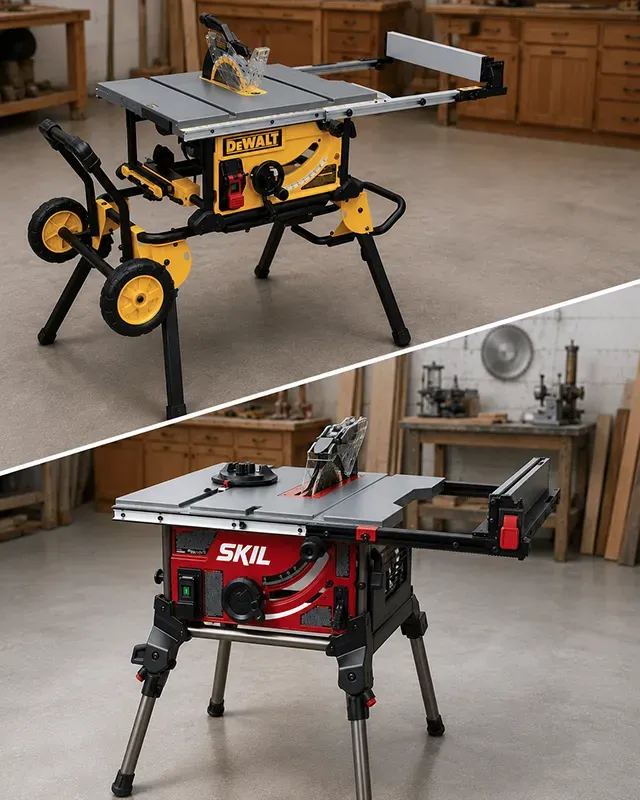
The stands dictate how these saws behave in a small shop. The DeWalt comes with a rolling stand. The saw sits on two wheels, allowing the user to tip it back and roll it easily across a driveway or shop floor. This is highly convenient for those who need to move the saw frequently over distance.
The Skil uses integrated folding legs that fold directly into the saw’s frame. While this design is clever and reduces the total number of parts, it lacks wheels. To move the Skil, the user must lift and carry the 59-pound machine. It is portable, but less mobile over long distances than the rolling DeWalt.
Garage Storage
When not in use, the DeWalt’s rolling stand folds up, storing the saw vertically. It stands like a hand truck against the wall. This is a proven, space-saving design, but it still commands a fairly tall vertical footprint.
The Skil’s integrated legs fold flush with the bottom of the saw, turning it into a compact, flat box. For woodworkers who prefer to store their saw under a workbench or on a deep shelf, the Skil offers a noticeably smaller storage profile.
Dust Collection
Jobsite saws inherently struggle with dust collection compared to enclosed cabinet saws, as the bottom of the tool is often open. Both saws feature standard 2-1/2 inch dust collection ports designed to connect to a shop vacuum, and the Skil includes a dust port elbow to help redirect waste into a bucket or bag if a vacuum is not attached.
Both machines can still release dust above the table, so above-table collection, ventilation, and respiratory protection remain worth considering for indoor work.
Dado and Blade Compatibility
Both saws accept standard 10-inch, 5/8-inch arbor blades, but their dado capabilities differ significantly.
DeWalt generally supports wider dado setups than the Skil, commonly listed around 3/4 inch to 13/16 inch depending on manual/version wording and insert compatibility. Before buying a dado throat plate, users should verify the exact saw type and compatible insert.
The Skil TS6307-00 officially limits maximum dado width to 5/8-inch and requires an 8-inch dado stack when using their specific dado insert. If cutting wide dados is a frequent part of your workflow, the Skil introduces notable setup friction.
Long-Term Ownership Friction
Every saw has maintenance realities. With the DeWalt, recurring complaints often center around the stock throat plate, which can sit slightly unevenly and may require leveling screws or a custom zero-clearance insert to sit perfectly flush.
With the Skil, ownership friction comes from the table surface itself. At this price point, casting tolerances are wider. One independent review measured about 1/32-inch variance across the table, which is worth mentioning for readers expecting furniture-grade joinery precision.
Which One Makes More Sense by Use Case
For the serious hobbyist or small shop owner who frequently builds furniture, uses full dado stacks, or needs to roll the saw out to the driveway every weekend, the DeWalt DWE7491RS justifies its higher cost through superior sheet-good support, robust fence mechanics, and wider dado capabilities.
For the weekend DIYer, homeowner, or woodworker who needs accurate ripping on a strict budget, the Skil TS6307-00 is an excellent compromise. It delivers the parallel accuracy of a rack-and-pinion system without the premium price, provided the user is willing to accept a narrower rip capacity, lack of wheels, and a 5/8-inch dado limitation.