
Table Saw Blades by Cut Type: Rip, Crosscut, Plywood & General Use
INFO
Evidence Level: Level 1 - Manufacturer Specifications + Mechanical Analysis + Owner Feedback Synthesis.
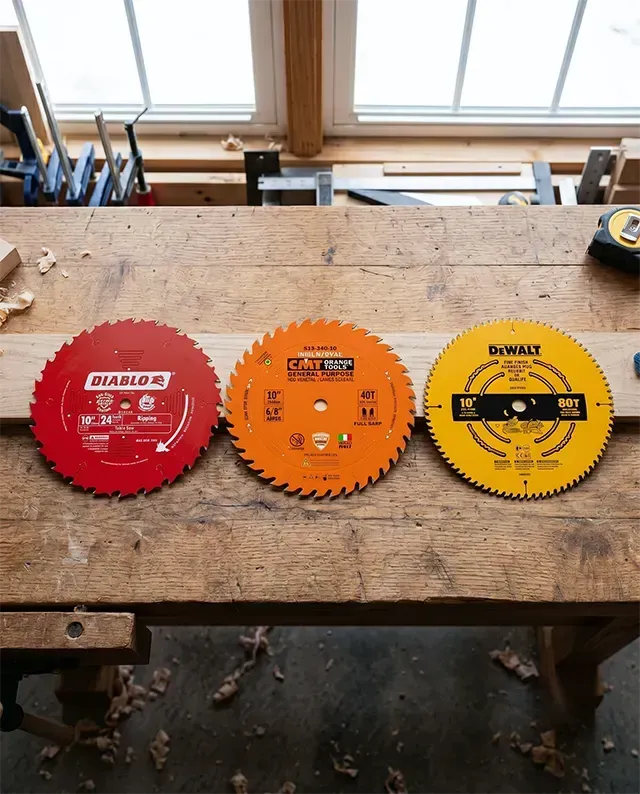
Many table saws ship with a basic general-purpose or construction-oriented blade. Depending on the saw, that blade may be closer to a rough framing blade than a fine woodworking blade. It will cut wood, but it will not cut it exceptionally well. The factory blade is a compromise designed to handle a little bit of everything so you can turn the saw on out of the box.
In a woodworking shop, there is no single “best” blade that excels at every operation. Leaving a single blade in the saw for every cut forces you into mechanical tradeoffs. Ripping thick hardwood with a crosscut blade risks burning the wood and warping the blade plate. Crosscutting a veneered panel with a rip blade often causes heavy tearout.
Finding the right blade is a decision guide based entirely on the direction of the wood grain and the material you are cutting. Understanding why table saw blades behave the way they do requires looking at a few core mechanical factors. For a deeper foundation, start with our table saw blades explained guide.
The Mechanics of a Saw Blade
Before looking at specific blade categories, it helps to understand how the geometry dictates the cut.
- Tooth Count: More teeth generally mean a smoother cut but a slower feed rate. Fewer teeth mean a faster, rougher cut. For a closer look at how density affects feed rates, see our guide on tooth count.
- Gullets: The empty curved space in front of each tooth. Gullets act as a bucket to carry sawdust out of the kerf. Fewer teeth allow for larger gullets; a high tooth count forces smaller gullets.
- Hook Angle: The forward or backward lean of the tooth. Lower hook angles reduce self-feeding behavior and can feel more controlled, but ripping blades on table saws commonly use positive hook angles, often up to 20 degrees, to maintain feed efficiency. For more detail, see our guide to table saw blade hook angle.
- Tooth Grind: The shape of the carbide tip. Different shapes slice, chop, or scrape the wood fibers depending on the material. For a deeper comparison, see FTG, ATB, and TCG blade grinds.
1. Rip Blades: Cutting With the Grain
Ripping means cutting wood parallel to the grain. Mechanically, this process does not sever fibers; it splits them apart, peeling long, stringy shavings off the board. A rip blade vs crosscut blade comparison fundamentally comes down to sawdust evacuation.
Because of the volume of material removed, clearing sawdust quickly is the top priority. If the sawdust cannot escape, it builds up in the kerf, creating intense friction. This heat can burn the wood, increase feed resistance, and contribute to blade-plate stress.
To handle this, true rip blades have a low tooth count—usually 24 or 30 teeth on a 10-inch blade. This leaves room for massive gullets that can evacuate stringy sawdust efficiently.
Common Specifications:
- Teeth: 24T or 30T
- Hook Angle: High positive, around 20 degrees, for aggressive feeding.
- Grind: Flat Top Grind (FTG). The top of the tooth is perfectly flat, acting like a chisel to hog out material. Because it is flat, an FTG blade leaves a square-bottom groove, making it useful for cutting splines or box joints.
The Tradeoff:
Rip blades leave a slightly rough edge. You will usually need to run the ripped edge over a jointer or hit it with a hand plane before edge-gluing. If you attempt to crosscut with a rip blade, trailing-edge tearout becomes much more likely, especially on brittle hardwoods, plywood, or veneered panels.
2. Crosscut Blades: Severing Across the Grain
Crosscutting means cutting perpendicular to the wood grain. Instead of peeling fibers away, the blade has to sever short, brittle straws of wood. If the cut is not clean, the fibers splinter and tear out as the blade exits the wood.
To get a clean edge, a crosscut blade uses a high tooth count—typically 60 to 80 teeth. The teeth take tiny bites, and the small gullets prevent the blade from feeding too quickly.
Common Specifications:
- Teeth: 60T to 80T
- Hook Angle: Typically lower than a rip blade, often around 5–10 degrees positive on table-saw crosscut blades. Negative hook angles are more common on miter/radial-arm applications.
- Grind: Alternate Top Bevel (ATB). The teeth alternate leaning left and right, creating a sharp point on the outside edge. This acts like a scoring knife, slicing the fibers cleanly on both sides of the kerf before the center of the tooth clears the waste.
The Tradeoff:
Crosscut blades generate a lot of heat if pushed too hard. If you try to rip a 2-inch thick piece of maple with an 80T crosscut blade, the small gullets can pack with sawdust quickly, the wood can burn, and the resistance can bog down the saw motor.
3. Plywood and Melamine Blades: Beating Tearout
Plywood, melamine, and veneered MDF are notoriously difficult to cut because the ultra-thin top layer wants to chip away. The core material is usually unstable, meaning you are essentially crosscutting fragile fibers no matter which way you push the panel. For a deeper breakdown of veneer tearout and laminate wear, see our guide to table saw blades for plywood and melamine.
Plywood blades take the concept of a crosscut blade to the extreme, but the grind geometry varies based on what you are cutting.
Common Specifications:
- Teeth: 80T or 90T
- Hook Angle: Low positive or slightly negative.
- Grind (Veneer/Plywood): High-ATB (Hi-ATB). The bevel angle on the alternating teeth is pitched extremely steep, often 30 to 40 degrees. This creates a sharp, needle-like point that scores fragile veneers before the rest of the tooth clears the waste.
- Grind (Melamine/Laminate): Triple Chip Grind (TCG). Hi-ATB is excellent for clean veneers, but TCG is worth considering when laminates or melamine are highly abrasive and durability matters more than an ultra-sharp edge. TCG trades a slightly different cut character for much better long-term wear resistance.
The Tradeoff: Hi-ATB teeth are incredibly fragile. The sharp points wear down much faster than standard ATB, TCG, or FTG teeth. These blades are expensive to buy and require more frequent sharpening. You should reserve your Hi-ATB blade exclusively for sheet goods and avoid using it for general lumber breakdown.
4. General Purpose and Combination Blades: The Compromise
For many woodworkers, stopping to change a blade between a rip and a crosscut is a workflow killer. General-purpose and combination blades are engineered to handle both tasks reasonably well, though they achieve this through slightly different designs.
A true combination blade usually features 50 teeth arranged in groups of five. The layout includes four ATB teeth to handle the crosscutting and scoring, followed by one Flat Top (FTG) raker tooth to clear out the kerf, separated by a deep gullet to help evacuate sawdust during rips. A 50T grouped-tooth blade is the classic version of this compromise. We cover one example in detail in our CMT combination blade review, including its 4+1 tooth layout and 0.102-inch kerf behavior. For a more accessible 50T combination option, see our Diablo D1050X review.
A general-purpose blade typically uses 40 teeth with a standard ATB grind and medium-sized gullets. For specific examples in this category, see our evidence-based reviews of the Freud LU83R010 and Forrest Woodworker II.
Common Specifications:
- Teeth: 40T (General Purpose) or 50T (Combination)
- Grind: ATB (General Purpose) or ATB/R (Combination).
The Tradeoff:
A 40T or 50T blade is a master of none. It will leave more tearout on a crosscut than an 80T blade, and it will require more feed pressure and generate more heat on a thick rip than a 24T blade. However, if you are primarily working with 3/4-inch stock or thinner, a high-quality general-purpose or combination blade is usually adequate for many shop tasks.
Thin Kerf vs. Full Kerf: Matching the Blade to the Motor
Kerf refers to the width of the slot the blade cuts in the wood, which is determined by the thickness of the carbide teeth.
Full Kerf (1/8-inch): Requires a powerful motor to push through the wood. The thick steel plate absorbs vibration and resists deflecting under heat. Full-kerf blades are usually a better match for 3 HP cabinet saws and other saws with enough torque to maintain RPM under load.
Thin-kerf blades (3/32-inch): Remove about 25 percent less material. This significantly reduces the strain on the motor. Thin-kerf blades are usually a better match for 15-amp jobsite saws and lower-powered contractor saws. If you are not sure how your saw class affects blade choice, see our jobsite vs contractor table saw guide. The downside is that thin steel plates can flutter or deflect slightly if pushed too hard, which can leave faint tooling marks on the edge of the wood.
What Not to Buy First
When upgrading from a factory blade, it is easy to make assumptions that lead to wasted money. Based on common ownership friction, here is what you should avoid:
- Do not buy an 80T plywood blade as your only blade if you frequently rip hardwood. You will burn the wood and shorten the useful life of the blade.
- Do not buy a full-kerf premium blade for an underpowered jobsite saw if your motor already bogs down on thick cuts. The saw will struggle to spin the extra mass. To understand other constraints on portable models, see our first table saw buying guide.
- Do not assume a high tooth count means a better blade. Grind geometry, plate tensioning, carbide quality, and sharpenability matter just as much as the number of teeth.
- Do not buy a negative-hook miter saw blade as a default choice for table saw ripping. It is designed for a different feed direction and can make table saw ripping feel inefficient or difficult to control.
The Verdict: What Should You Keep in the Saw?
If you only have the budget for one good blade, consider a high-quality 40T general-purpose or 50T combination blade. It will usually outperform a basic factory blade and handle most weekend projects.
If you are building out a long-term shop capability, the most practical approach is a two-blade system:
- A 24-tooth rip blade for breaking down rough lumber and sizing parts.
- An 80-tooth crosscut/plywood blade for cutting joinery, sled work, and sizing sheet goods.
Swapping blades takes less than two minutes. Taking the time to match the tooth geometry to the operation protects your saw’s motor, extends the life of your carbide, and reduces the time you will spend sanding out burn marks.