
Zero-Clearance Table Saw Inserts: Tearout, Kerf Fit, and Dado Limits
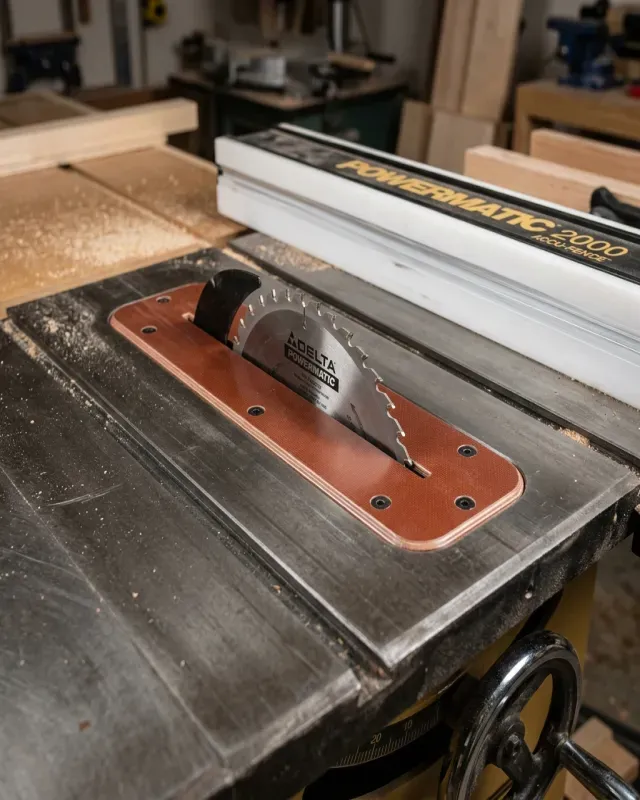
INFO
Evidence Level: Level 1 — Document Lab + Mechanical Analysis + Owner Feedback
Every table saw ships with a factory throat plate that leaves a wide gap around the blade. Manufacturers leave clearance around the blade so the throat plate can accommodate different blade widths and blade positions, including bevel cuts.
While necessary for universal function, that wide gap can contribute to two problems: tearout on the bottom face of your cuts, and a gap where thin offcuts or narrow strips can fall into the throat opening and create a potential kickback hazard.
Swapping the factory plate for a zero-clearance table saw insert is widely considered a highly effective upgrade for cut quality, but it introduces its own set of rigid constraints. Because the insert perfectly matches the blade, changing your setup often means changing the insert.
The Mechanics of Tearout and Fiber Support
To understand why a zero clearance insert for table saw operations works, you have to look at how the blade teeth interact with the wood.
The table saw blade rotates toward you, meaning the teeth enter the top surface of the workpiece and exit through the bottom surface. The top surface typically experiences less exit-side tearout because the fibers are supported by the material surrounding the cut. But as the tooth exits the bottom of the board, it pushes the wood fibers downward.
If there is a wide gap in the throat plate, those downward-pressed fibers have nothing pushing back. They can splinter and tear, particularly when cutting fragile or veneer-faced materials such as plywood.
A zero-clearance insert is cut to match the kerf of the blade or blade setup you intend to use. Because it hugs the blade tightly, the insert supports the fibers closer to the blade, reducing the amount of unsupported material that can splinter as the tooth exits.
Kerf Fit: Why One Insert Isn’t Enough
The defining feature of a zero-clearance insert is also its biggest limitation: it is a custom fit for a specific blade kerf or blade setup.
A typical thin-kerf blade may produce a kerf around 3/32”, while a conventional full-kerf blade is commonly around 1/8”. If you cut your insert using a thin-kerf blade and later swap to a standard 1/8” blade, the thicker carbide teeth will strike the insert. Conversely, if you cut the insert with a full-kerf blade and later install a thin-kerf alternative, you have reintroduced a small gap, sacrificing a portion of the fiber support.
Because of this rigid kerf matching, woodworkers often maintain a small library of inserts:
- One for 90-degree 1/8” crosscuts and rips.
- One for 90-degree thin-kerf cuts.
- One specifically for 45-degree bevels.
A 90° zero-clearance insert is not automatically a zero-clearance solution for 45° bevel cuts. Tilting the arbor shifts the physical path of the blade through the table, requiring a uniquely slotted plate.
Dado Limits and Box Joints
The need for fiber support becomes critical when cutting joinery. If you are milling dados, rabbets, or using a table saw finger joint jig, tearout on the bottom of the cut can ruin the mechanical fit and the visual line of the joint.
Dado stacks can be configured to different cutting widths, and the maximum supported width depends on the saw and dado set. A single zero-clearance insert cannot provide a closely matched opening for every dado width. Mechanically, you must either fabricate a dedicated insert for your most common dado width, or accept that a wider slot won’t provide zero-clearance support on narrower stacks.
If you are calculating kerf loss for precise joinery spacing, having a clean, low-tearout reference edge is highly beneficial. Relying on a standard wide-mouth throat plate with a dado stack leaves more of the cut unsupported and can increase splintering on cross-grain cuts.
Riving Knives and the Safety Tradeoff
A major discussion point in independent reviews and forums regarding zero-clearance inserts is the integration of the riving knife.
Creating a zero-clearance slot may require temporarily removing the riving knife, depending on the saw and the specific insert design. That does not make the insert itself a substitute for the riving knife. For through-cuts, choose or modify an insert so the saw’s specified guarding and riving-knife system can be used as intended, and verify proper clearance before operation.
For non-through cuts (like dados), the setup will differ. Always refer to your saw’s manual regarding the appropriate guarding and riving knife configuration for non-through operations.
DeWalt Table Saw Zero-Clearance Inserts
Saws like the DeWalt DWE7491RS rely on specific throat plate shapes. The insert geometry is model-specific, including the rear locating features, a front cam lock, and multiple leveling screws.
DWE7491RS (10-Inch)
The throat plates for the 10-inch DeWalt saws are widely supported by aftermarket companies like Leecraft. Phenolic is commonly used in aftermarket inserts because it provides a rigid, dimensionally stable sheet material. Manufacturers market phenolic inserts for durability and resistance to wear and deformation, while their smooth surface provides a low-friction contact area for the workpiece.
DWE7485 (8-1/4 Inch)
The compact DWE7485 is a different case. DeWalt states that this model is not compatible with dado sets, so a dado-specific throat plate should not be treated as an option for this saw. Zero-clearance insert options for the DWE7485 should therefore be evaluated primarily around single-blade cuts, kerf width, and bevel clearance.
Why Insert Fit Changes
A zero-clearance insert is only zero-clearance relative to the opening that was originally cut into it.
The opening can also become less useful as the insert wears or as the saw setup changes. A wider-kerf blade, a dado setup, or a different bevel angle can enlarge or invalidate the original opening.
Ultimately, a zero-clearance insert is not a universal upgrade. It is a setup-specific interface between the blade, the insert, and the operation, and it requires careful matching to provide its primary mechanical benefit.