
What Size Table Saw Do You Need for a Garage Shop?
NOTE
Evidence Level: Level 0 — Theory Lab
This article explains table saw sizing using blade geometry, published specifications, and garage workflow mechanics. It does not include physical testing of specific table saw models.
When planning a garage workshop, the table saw is usually the centerpiece. However, choosing the right size is rarely as simple as buying the largest machine you can afford. In a shared garage space, every square inch matters, and overestimating your needs can quickly result in a cramped, unworkable shop.
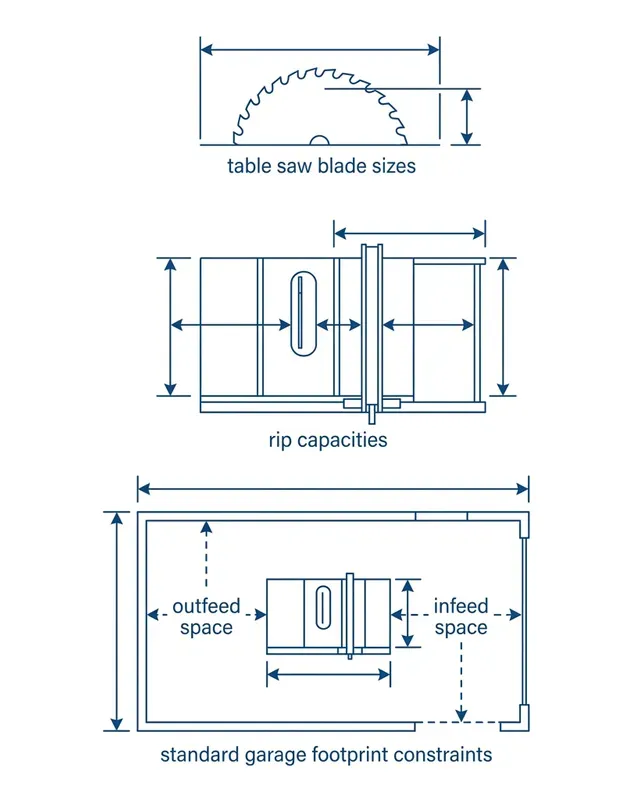
Table saw “size” actually refers to three distinct measurements: the blade diameter, the rip capacity, and the physical footprint of the machine itself. Understanding how these specifications translate to workshop mechanics will help you make a practical decision.
Table Saw Size Is Really Three Measurements
Before looking at specific models, it helps to separate the different ways a table saw is measured.
First, the blade diameter determines your maximum depth of cut. Second, the table saw rip capacity dictates how wide of a board or panel you can process against the fence. Finally, the physical footprint determines how the tool fits into your shop layout.
It is also important to note that blade diameter is not the same as the saw’s class. A 10-inch portable jobsite saw and a 10-inch stationary cabinet saw both use the same size blade, but they are entirely different tools. Two saws can share the same blade diameter while behaving very differently under load because the fence, arbor, trunnion design, table mass, and motor system are different.
Blade Diameter: 8-1/4, 10, or 12 Inch
The diameter of the blade dictates what materials you can practically process in a single pass.
The 8-1/4 Inch Table Saw
In recent years, the 8-1/4 inch table saw has become incredibly common, especially in the portable table saw category. This shift was driven by several factors: smaller portable designs, lighter jobsite tools, lower blade mass, and the broader move toward compact saw platforms.
- Max Cut Depth: Typically around 2-1/2 to 2-5/8 inches at 90 degrees.
- Capabilities: Easily handles 3/4-inch sheet goods and standard 2-by framing lumber (which is 1.5 inches thick).
- Limitations: An 8-1/4 inch saw is not a good choice for routine 4x4 work. Although a flipped two-pass cut may be physically possible on some setups, the small table, limited cut height, and registration problems make it a poor workflow compared with a larger saw, miter saw, or circular saw. Furthermore, you will find fewer blade options than in the 10-inch category, and these smaller saws generally cannot safely run a dado stack for cutting joinery grooves. (Models like the popular DeWalt DWE7485 explicitly do not support dado blades).
The 10 Inch Table Saw
The 10-inch table saw remains the default size for most hobbyist, contractor, and small-shop table saws.
- Max Cut Depth: Usually around 3-1/8 inches at 90 degrees.
- Capabilities: A 10-inch saw has the blade height for many thick boards, but cutting 12/4 hardwood cleanly depends on motor power, blade selection, feed rate, and the wood itself.
- Advantages: The biggest advantage is the tooling ecosystem. The variety of 10-inch blades available—thin-kerf, flat-top grind, dedicated ripping, and specialized crosscut blades—is massive. Many 10-inch contractor, hybrid, and cabinet saws can accept an 8-inch dado stack, but dado capacity is model-specific and must be confirmed in the manual.
- A Note on Riving Knives: When buying a 10-inch saw, pay attention to riving knife compatibility. Most saws ship with a riving knife sized for a standard blade kerf. If you switch to a thin-kerf blade to reduce motor strain on a smaller saw, you must ensure your riving knife is thinner than the blade kerf to prevent the wood from binding.
The 12 Inch Table Saw
A 12-inch table saw moves into a heavier-duty category, usually beyond what most garage woodworkers need. With maximum cut depths approaching 4 inches, these machines are built for high-volume cabinet shops and timber framers. They often involve heavier electrical, weight, and footprint requirements than a shared garage shop is designed around.
Rip Capacity: How Wide Can You Cut?
Rip capacity is the maximum distance between the spinning blade and the rip fence.
- Under 24 inches: Common on ultra-compact saws. This capacity restricts you to narrow boards and small projects.
- 24 to 28 inches: The standard for quality jobsite saws and compact contractor saws. A 24-inch capacity reaches the center of a 48-inch sheet, but safely handling a full 4x8 panel still requires excellent infeed, outfeed, and side support.
- 30 to 36 inches: The sweet spot for serious garage woodworkers. Found on most hybrid and cabinet saws, this capacity gives you enough room to maneuver large cabinet parts and furniture panels without dominating the entire garage.
- 50+ inches: Available on large cabinet saws, these rails extend far to the right of the blade. While excellent for production cabinet shops breaking down sheet goods all day, they consume an enormous amount of floor space. Long rails frequently become an expensive storage shelf for clutter in small shops.
In a garage environment, full 4x8 sheets of plywood are usually broken down into manageable pieces with a circular saw or track saw first. A track saw is often a more space-efficient solution for initial panel breakdown than trying to muscle a heavy sheet over a table saw.
Footprint: Storage Size vs Working Size
When planning your shop layout, you must measure the saw in use, not just the saw in storage. A folded portable table saw may occupy a small corner, but ripping a 6-foot board requires clear space in front of the blade, over the table, and behind the blade.
- Portable/Jobsite Saws: These saws feature cast aluminum tops and lightweight frames. They can be folded up and tucked away easily. However, a lighter aluminum-top saw has less mass to resist vibration and movement. Mechanically, that can make setup, support, and feed consistency more important than on a heavier cast-iron saw.
- Contractor and Hybrid Saws: These saws introduce cast iron tops. The mass of cast iron helps resist vibration and movement, which supports more repeatable setup and feed control. The deeper table also provides a safer registration surface before the wood meets the blade. They require a dedicated footprint, though installing a high-quality mobile base allows them to be rolled out of the way.
Outfeed Support Matters More Than Most Beginners Think
When evaluating table size, it is critical to separate the saw’s internal dimensions from the external support you provide.
Mechanically, a smaller table saw embedded into a custom workbench with ample outfeed support is significantly safer and more capable than a standalone, heavy-duty saw with no outfeed support. When the wood clears the back of the blade, it needs somewhere to go. Balancing a long board while simultaneously trying to push it through the blade creates leverage that pushes the wood away from the fence, increasing the risk of binding and kickback.
If your garage is tight, prioritizing floor space for an outfeed table or a multi-purpose assembly bench is often a better investment than paying for maximum rip capacity on the saw itself.
Making the Decision
Choosing the right size comes down to matching the machine to your realistic workflow and the physical realities of your space.
| If your primary work is… | And your garage space is… | Consider… |
|---|---|---|
| Home repairs, framing, jobsite travel | Shared with cars, very limited | 8-1/4” or 10” portable saw. Excellent storage footprint, though you sacrifice mass, dado capability, and large panel support. |
| Weekend furniture making, DIY builds | Shared, but you have room to roll a tool out | 10” jobsite or compact contractor saw. Better table depth and fence stability than a portable saw, usually with 24-30” rip capacity. |
| Serious woodworking, cabinetry, joinery | Dedicated bay, stationary setup | 10” hybrid or cabinet saw with 30-36” rip. The added mass improves stability and supports more repeatable setup, and the motor can handle thicker hardwoods efficiently. |
| Breaking down full sheets all day | Large, dedicated workshop | 10” cabinet saw with 50”+ rip. Only recommended if you have the floor space to support the long rails permanently. |
For most garage shops, the best answer is not the largest saw. It is usually a 10-inch saw with enough rip capacity for your common projects, plus a reliable plan for outfeed support. Before buying the largest saw that fits your budget, sketch out your garage floor plan. Factor in the working space required for infeed and outfeed, and remember that a moderate-sized saw with excellent external support will always outperform a massive saw crammed into a corner.