
Thin-Kerf vs Full-Kerf Table Saw Blades: Load and Stability
INFO
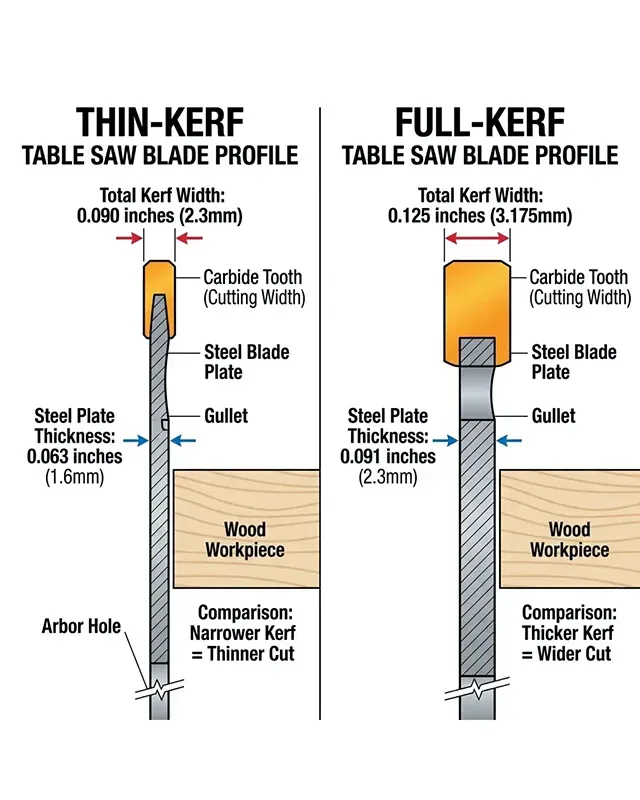
If you place two 10-inch table saw blades side by side, they might look identical across their face. However, as covered in our table saw blades explained guide, blade diameter is only one part of the system. Looking at the blade in profile reveals a second variable: the width of the carbide teeth and the thickness of the steel plate.
For 10-inch table saws, the industry generally divides blades into two standard categories:
- Full-Kerf: Typically measures 1/8 inch (0.125 inches) wide.
- Thin-Kerf: Typically measures 3/32 inch (0.094 inches) wide.
That difference of 1/32 of an inch seems negligible on paper. In practice, it alters how hard your motor works, how stable the blade remains under load, and how you set up your machine’s safety features.
Kerf Width Is Not the Same as Plate Thickness
Before comparing the two categories, it is important to distinguish the terms. Kerf is the actual physical width of the slot the blade cuts through the wood, which is determined by the width of the carbide teeth. The plate (or body) is the steel disc that holds those teeth.
Mechanically, the steel plate must always be slightly thinner than the kerf of the teeth. This creates side clearance, ensuring that the steel body does not rub against the freshly cut wood walls, which would cause severe friction and burning. When you buy a thin-kerf or full-kerf blade, both the tooth width and the corresponding plate thickness are scaled accordingly.
Motor Load and Horsepower Constraints
One major reason thin-kerf blades are manufactured is to reduce cutting resistance on saws with lower available power.
When a saw tooth strikes a piece of wood, it takes physical energy to shear that material away. Mechanically, a 3/32-inch thin-kerf blade removes about 25% less material width than a 1/8-inch full-kerf blade. That usually reduces cutting resistance, but the actual motor load also depends on tooth geometry, feed rate, wood species, blade sharpness, and setup.
- 120V Saws (Jobsite, Benchtop, and Contractor): These saws are usually limited by a 15-amp, 120V circuit rather than by the kind of sustained torque available from a 240V cabinet saw. If you feed a dense piece of maple into a full-kerf blade on a 15-amp jobsite saw, the motor is more likely to lose speed, especially if the feed rate is aggressive or the blade is not sharp. A thin-kerf blade reduces the amount of wood removed per pass, which can help these smaller motors maintain speed through the cut.
- 240V Saws (Cabinet Saws): Saws with 3 to 5 horsepower motors generally have enough torque to run a full-kerf blade in hardwood without the same level of RPM drop seen on smaller saws, assuming the blade is sharp and the feed rate is reasonable.
For review examples in this category, see our Freud LU83R010 and Diablo D1050X.
Plate Stability and Deflection
If thin-kerf blades are easier on the motor, the natural question is why 240V saw owners don’t universally use them. The main tradeoff is stability.
Because a thin-kerf blade features a thinner steel plate, it lacks the physical mass of a full-kerf blade. Under heavy load—or as heat builds up during a long rip cut in dense stock—a thinner plate is more susceptible to deflection (a harmonic wobble or bending in the steel).
When a blade deflects, the cut may show more tooth marks, burning, or a less consistent sidewall. Joinery cuts, like tenons, may also suffer from an uneven surface. It is worth distinguishing this load-induced deflection from table saw runout, which is a mechanical wobble present even when the blade is spinning freely without a load.
A thicker full-kerf plate has more mass and stiffness, so it generally resists side loading, heat movement, and vibration better than a thinner plate. All else equal, the thicker plate of a full-kerf blade is mechanically better positioned to resist deflection. That can help preserve a more consistent cut path, especially in dense stock. However, it does not guarantee better cut quality by itself; tooth count, grind, sharpness, and feed rate still dictate the final result.
Why Stabilizers and Blade Design Complicate the Simple Rule
It is worth noting that a thin-kerf blade is not automatically unstable. High-quality thin-kerf blades utilize factory tensioning, laser-cut anti-vibration slots, specialized tooth geometry, and high-grade carbide to counteract the thinner plate.
A sharp, well-designed thin-kerf blade will often cut cleaner and straighter than a dull or poorly manufactured full-kerf blade. The rule of full-kerf being more stable applies strictly when comparing blades of equal quality, condition, and design.
The Riving Knife Safety Trap
The most critical factor when choosing between thin and full-kerf blades is your saw’s riving knife.
A riving knife sits directly behind the blade to prevent the two halves of the cut board from pinching together, which is a primary mechanical cause of table saw kickback. For a riving knife to function safely, it must obey a strict physical rule: It must be thinner than the kerf of the teeth, but thicker than the steel plate of the blade.
- If the riving knife is thicker than the kerf, the wood will bind against the knife as you push it through, trapping the workpiece and requiring you to dangerously force the cut.
If you buy a saw equipped for full-kerf blades and switch to a thin-kerf blade without changing the riving knife, you risk creating this exact binding scenario.
Do not judge compatibility by blade diameter alone. A 10-inch blade can still have a kerf that is too narrow for the factory riving knife. Some saws include or offer riving knives that cover a specific kerf range, but you should never assume compatibility. Always check the saw manual or measure the blade kerf, blade plate/body thickness, and riving knife thickness directly.
Material Waste
While secondary to motor power and safety, material yield is a practical consideration for woodworkers milling expensive hardwoods.
Losing 1/8 inch of material to sawdust on a single cut is rarely an issue. But if you are ripping thin strips for edge banding or laminations, that 1/32-inch difference per cut accumulates. Over a dozen cuts on a single board, a full-kerf blade turns an extra 3/8 inch of your stock into sawdust compared to a thin-kerf blade.
Which Kerf Makes Sense for Your Saw?
Your saw’s motor power and riving-knife compatibility should decide the starting point. From there, cut quality, yield, and blade design determine the final choice.
If you are setting up a machine based on our first table saw buying guide, a thin-kerf blade is generally the more practical starting point for 120V portable and contractor saws to keep the motor operating efficiently. Conversely, if you run a 3HP cabinet saw and need maximum plate stiffness for heavy hardwood ripping, a full-kerf blade takes advantage of your machine’s available torque.
Regardless of which profile you choose, proper table saw blade alignment still matters. Kerf choice affects cutting resistance and blade stiffness, but alignment determines whether the blade, miter slot, fence, and riving knife are working in the same path. For blade selection by cut type, see our guide to table saw blades by cut type.