
Table Saw Setup for a Small Garage: Space, Outfeed, Dust, and Safety
NOTE
Evidence Level: Level 0 — Theory Lab
The layout and setup strategies discussed below are based on mechanical principles and long-term ownership feedback from garage woodworkers.
Operating a table saw in a single-car garage or half of a two-car space requires a different approach than outfitting a dedicated woodshop. You do not have the square footage for a heavy cabinet saw with a 52-inch cast-iron table. Instead, a small table saw for wood—typically a jobsite table saw or benchtop model—is the realistic choice.
Compared with heavier cabinet saws, portable saws have less mass and more open housings. That makes stability, vibration control, and dust capture more dependent on the stand, cart, floor, and vacuum setup. Setting up a portable table saw safely in a tight area means compensating for these mechanical realities.
Before planning the layout, it helps to choose the right portable saw format. A compact carry-style saw saves storage space and is easier to lift onto a shelf or cart, while a larger rolling-stand jobsite saw gives you more table support, cut depth, stand stability, and sometimes dado compatibility. We break down those mechanical tradeoffs in our guide to compact vs jobsite table saws.
Small Garage Table Saw Setup Checklist
When preparing your workspace, start with a baseline configuration:
- Confirm the saw has a stable base or locking cart.
- Orient the saw so the outfeed path points toward the longest open area, usually the open garage door.
- Add outfeed support before cutting long boards or sheet goods.
- Keep the outfeed surface slightly lower than the saw table.
- Connect a shop vac or dust extractor to the dust port.
- Keep push sticks, riving knife, blade guard, hearing protection, and eye protection stored on or near the saw.
- Recheck fence parallelism after moving or bumping the saw.
Table Saw Stand vs. Custom Cart: Choosing the Base
Because small shops usually require tools to move out of the way when not in use, a stationary base is rarely practical. You generally have two choices: relying on a factory-built table saw stand or building a custom wooden workstation.
Option 1: Factory Rolling Stand
Purchasing a table saw with stand integration—specifically the gravity-rise or scissor-lift style—is often the fastest way to gain mobility.
Factory rolling stands are built around storage and deployment. They allow the saw to fold up vertically and park tightly against a wall. They can also be rolled toward the driveway when the weather and workspace allow, which gives you more outfeed room and keeps some of the dust load out of the garage. For a small garage, the best table saw stand is not always the heaviest one; it is the one that locks securely, rolls predictably, and stores without blocking the main walking path.
However, tubular steel or aluminum stands have little mass, meaning they do very little to dampen the high-frequency vibration of a universal motor.
Option 2: A Custom Portable Table Saw Table
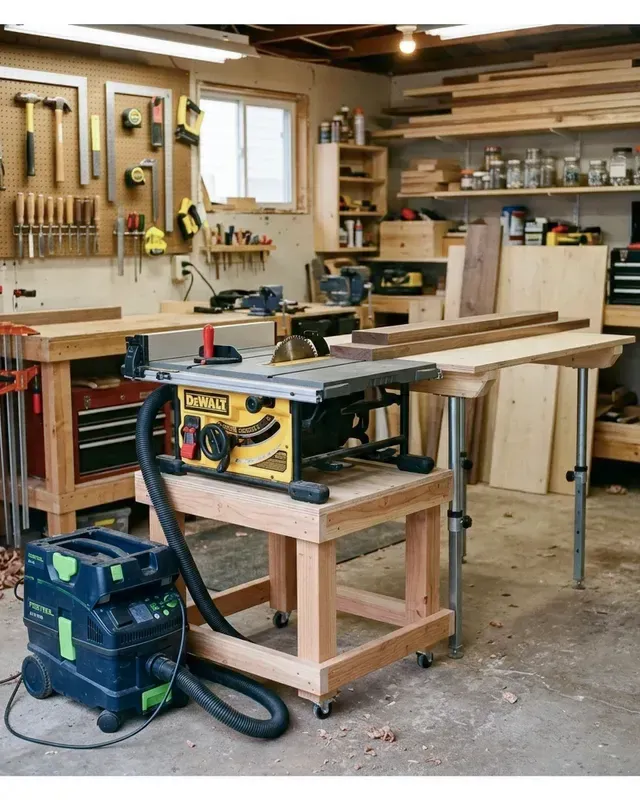
Many garage woodworkers eventually build a custom wooden workstation. These are typically plywood or MDF cabinets mounted on heavy-duty locking casters, with the saw recessed so its deck sits flush with the top of the cabinet.
Building a heavy portable table saw table addresses the lack of mass inherent to jobsite saws. The added mass can reduce how much the workstation moves during a cut. It may also make the saw feel less nervous, but it does not automatically improve blade quality, arbor runout, fence alignment, or cut accuracy. It also utilizes the empty space underneath the saw for drawer storage. The primary tradeoff is that a wooden cart cannot fold vertically, permanently occupying floor space.
Solving the Table Saw Outfeed Problem
One of the biggest practical risks with a compact saw is the lack of support behind the blade. When you push a long board through a jobsite saw, gravity wants to pull the back end of the board down as it clears the short table. If you try to counter this by pressing down on the front of the board, you risk lifting the wood off the blade at the rear, which invites severe kickback.
For long boards, a reliable table saw outfeed solution should be treated as part of the setup, not an accessory.
Best Option: The Assembly Table as Outfeed
If you have the floor space for a workbench, building it to act as an outfeed surface is highly efficient. When it is time to rip lumber, you simply roll the saw in front of the workbench.
Setup rule: Set the outfeed surface slightly lower than the saw table—about 1/16 inch is a useful starting point. The goal is simple: the workpiece should slide onto the support without catching its leading edge. If the outfeed table is even slightly higher than the saw deck, or if a caster sits in a low spot on the floor, the wood will abruptly stop, creating a dangerous situation.
Compact Option: The Folding Outfeed Extension
If a permanent assembly table takes up too much room, a folding outfeed extension attached directly to the saw or its stand is the next best option. Using heavy-duty drop-leaf brackets, you can attach a section of 3/4-inch plywood behind the saw. When deployed, it catches the wood. When folded down, the saw maintains its small footprint.
Occasional Option: Roller Stands
Standalone roller stands can work for occasional support, but they are easy to misalign and easy to bump in a tight garage. A single cylindrical roller can also influence the board’s path if it is not square to the feed direction, steering the wood away from the fence during a cut.
Dust Collection in a Small Garage
Cabinet saws enclose the blade inside a large base, making dust collection highly efficient. Portable saws often have more open lower housings, so dust capture depends heavily on the blade shroud, dust port, hose fit, and vacuum airflow. In a small, enclosed garage, airborne wood dust quickly becomes a respiratory hazard. A shop vacuum is the minimum requirement.
To improve capture efficiency:
- Check the port size: Most compact saws use a 2-1/2 inch dust collection port. Standard shop vac hoses often require a friction adapter to fit securely.
- Use a cyclone separator: Routing the vacuum hose through a 5-gallon bucket with a cyclone separator catches the heavy debris before it reaches the filter. This helps maintain suction longer, preventing the filter from blinding over with fine dust during long milling sessions.
Safety Rules That Matter More in a Small Garage
Working in tight quarters amplifies specific risks. Maintaining strict safety habits is critical when your workspace is limited.
- Do not rip long boards without proper outfeed support.
- Do not stand directly behind the blade path.
- Do not remove the riving knife for normal through cuts.
- Lock all casters on mobile bases or carts before turning on the saw.
- Keep the garage floor clear of cords, vacuum hoses, offcuts, and trip hazards.
- Do not use the garage wall, shelving, or a closed door as an accidental outfeed stop.
- Consistently use hearing protection, eye protection, and appropriate dust protection.
Garage Layout: Infeed, Outfeed, and Walking Space
Even with a highly mobile setup, orientation matters. You need sufficient clearance in front of the saw (infeed) to handle the material, and enough clearance behind it (outfeed) to complete the cut without trapping the board against a wall.
Setting the saw so the outfeed path points toward the open garage door usually gives you the longest available feed path. It also allows a large portion of the airborne dust to vent outside naturally.
When choosing a saw, evaluate the fence mechanics carefully. Space constraints mean you will frequently bump the saw or have to muscle it around. A rack-and-pinion fence can make repeated fence adjustments easier and can help keep both ends of the fence moving together, but it still needs to be checked for parallelism. Maintaining blade-to-fence parallelism is one of the core requirements for reducing binding and kickback risk, regardless of how small the shop is.
What This Setup Cannot Solve
A better stand, cart, or outfeed table improves workflow, but it does not turn a portable saw into a cabinet saw. It will not correct blade runout, a poor fence lock, a warped tabletop, or an underpowered motor. If the saw consistently burns wood, wanders during rip cuts, or loses fence alignment after normal use, the setup may not be the only issue. At that point, check blade condition, fence parallelism, arbor runout, and riving knife alignment before blaming the garage layout.
Building a functional garage shop around a portable table saw requires acknowledging its limitations. By managing the outfeed path, stabilizing the base, and handling the dust output, you create a safer and more predictable environment for cutting.