
What Is Runout? Table Saw Arbor and Blade Wobble Explained
NOTE
Evidence Level: Level 2 — Protocol Lab
This article explains the measurement concept and diagnostic sequence. It does not report physical runout measurements from a specific saw.
Runout: The measurable deviation of a rotating mechanical part from its intended path. On a table saw, this presents as side-to-side wobble in the arbor shaft, the flange, or the blade as they spin.
Every rotating component in a machine has some degree of imperfection. While marketing materials often emphasize motor horsepower or cast iron weight, runout affects the mechanical baseline of the saw. In practical terms, it can contribute to wider kerfs, saw marks, vibration, burning, and less predictable joinery.
Runout vs. Blade Alignment
A common point of confusion is mixing up runout with blade alignment. They are fundamentally different measurements.
Blade alignment describes the geometric relationship between the blade, the miter slot, and the rip fence when the saw is set up. Runout describes whether the rotating arbor or blade deviates from its intended path during rotation. A saw can be aligned well to the miter slot but still have blade runout, or it can have low runout but poor alignment.
Arbor Runout vs. Blade Runout
Understanding runout requires separating the machine from the consumable part. It is common to experience wobble, but identifying the source is the only way to correct it.
- Arbor Runout: This is the mechanical reality of the saw itself. It stems from how precisely the arbor shaft was machined at the factory, the quality of the arbor bearings, and the trueness of the fixed arbor flange face.
- Blade Runout: This is the deviation found in the saw blade body. Blades can warp due to heat buildup, tension loss over time, or manufacturing defects.
Why Small Errors Get Larger at the Teeth
Because the teeth are located roughly five inches from the arbor centerline, small seating errors at the flange, washer, or blade plate can become much more visible at the carbide teeth. A flat, premium blade cannot fully compensate for a damaged or poorly machined arbor flange, and a precise arbor cannot rescue a warped blade.
Axial vs. Radial Runout
On a table saw, woodworkers usually care most about axial runout because it moves the blade side-to-side across the kerf. Radial runout means the outer edge of the blade does not track a perfect circle around the arbor centerline. Both can matter, but axial movement is usually the more visible cause of widened kerfs and side rubbing.
How Runout Shows Up in the Cut
You may notice symptoms before you measure them, but symptoms alone cannot prove runout. Burning, saw marks, and vibration can also come from blade choice, feed rate, fence alignment, pitch buildup, or wood tension. However, when runout is the culprit, it generally presents in a few specific ways:
- Wider Kerf: The blade wobbles and carves a path wider than the actual thickness of its teeth, throwing off precise joinery measurements.
- Saw Marks: Excessive lateral movement leaves distinct, sweeping arc marks on the edge of the board instead of a flat surface ready for glue.
- Burn Marks: Wobble causes the back of the blade to rub against the wood after the initial cut, generating heat and leaving dark burn marks.
Practical Tolerance Ranges
There is no single universal number that applies to every table saw. Machinists work in ten-thousandths of an inch; woodworkers do not, largely because wood expands, contracts, and shifts with humidity.
With fine woodworking, the practical goal is for arbor and flange runout to be as close to zero as possible. Based on available discussion and long-term feedback, an arbor flange runout of 0.001 to 0.002 inches is generally considered very good.
When the total indicated runout (TIR) measured near the blade teeth approaches 0.010 inches, that is a strong signal to investigate further, especially if it is accompanied by burn marks, excessive vibration, or poor glue-line quality. Treat these numbers as diagnostic ranges, not universal pass/fail standards. The real question is whether the measured runout matches the quality demands of the work.
How to Isolate the Cause
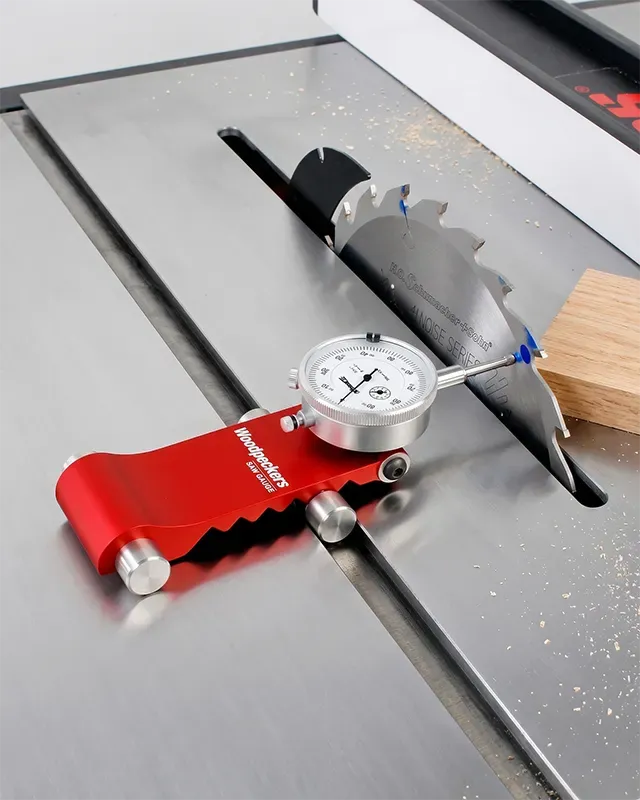
When cut quality drops, the issue is often simpler than a factory defect. Diagnosing runout requires a dial indicator with a magnetic base and a methodical approach to eliminate variables.
- Unplug the saw. Always disconnect power before handling the arbor or blade assembly.
- Clean the assembly. Thoroughly clean the arbor flange, the washer, and the blade plate. A microscopic layer of pitch, sawdust, or rust is the most common cause of sudden wobble.
- Test with a known blade. Install a blade that is known to cut cleanly or has been checked separately.
- Mark the position. Use a marker to note where the blade aligns with a specific point on the arbor flange, then measure the runout near the teeth.
- Rotate and remeasure. Loosen the arbor nut, rotate the blade 90 or 180 degrees relative to the arbor, tighten it, and measure again. If the high spot moves with the blade, the blade is warped. If the high spot stays fixed in the same location relative to the arbor, the issue is in the saw.
- Measure the arbor directly. If the readings remain fixed to the saw, remove the blade and measure the flat face of the arbor flange directly. Keep the indicator tip square to the measured surface where possible to avoid angle errors.
- Check the bearings. If arbor bearing play is suspected, stop using the saw and consult the manufacturer’s service procedure or a qualified technician. Do not grind, sand, or modify the arbor flange unless the manufacturer provides a specific service procedure.
When Runout Actually Matters
For rough framing or breaking down construction lumber, a few thousandths of an inch of wobble will rarely impact the final product. The demand for tight tolerances scales with the precision of your work. Box joints, dialed-in tenons, and rip cuts intended for immediate edge-gluing are where excess runout turns from a theoretical annoyance into a practical failure.
Understanding this baseline helps set realistic expectations for a machine. Runout is not a brand opinion or a feel test. It is a measurable condition.