
Table Saw Rip Capacity Explained: How Much Do You Really Need?
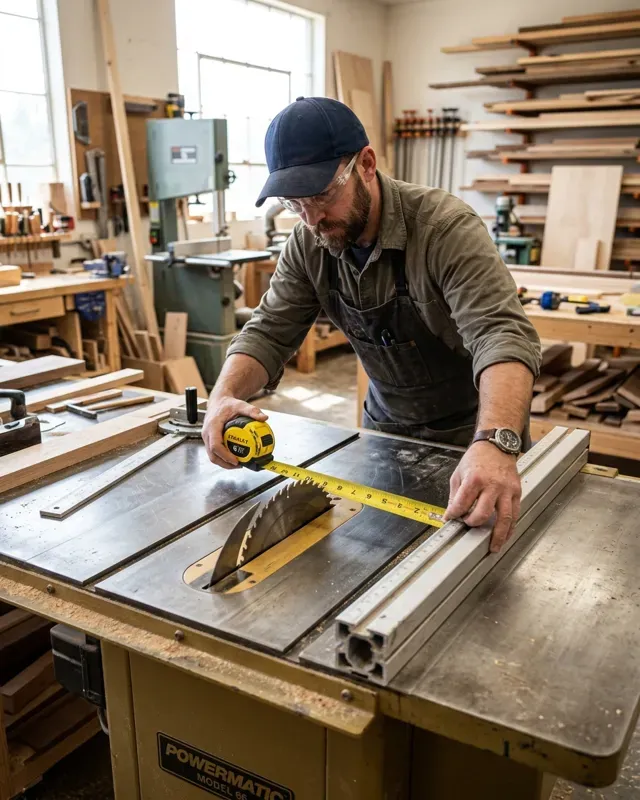
Table Saw Rip Capacity Explained: How Much Do You Really Need?
Evidence: Manuals, manufacturer specifications, owner feedback, and mechanical analysis.
Rip capacity is one of the most prominent specifications on any table saw box or product page. Manufacturers frequently use it as a shorthand for overall capability: a portable saw with a 32-1/2-inch capacity appears more capable than one with 25 inches, while a 52-inch cabinet saw setup sounds like the standard choice for furniture and cabinetry.
In a workshop, that single number tells an incomplete story.
Rip capacity is a fence-travel specification, not a measure of how much material a table saw can practically control. It defines the maximum rated horizontal distance between the saw blade and the fence face, but it reveals nothing about whether the machine’s table area, mass, or stand can safely support a workpiece of that size.
To model how different rail setups interact with your specific shop dimensions and cuts, our Rip Capacity Calculator lets you compare project widths against machine travel limits.
What Rip Capacity Actually Measures
Rip capacity is the maximum rated distance between the saw blade and the rip fence when the fence is locked at its furthest usable position along the guide rails.
In practice, this measurement carries several operational distinctions:
- Right-Side Orientation: Most manufacturers quote right-of-blade capacity, which is where standard ripping takes place. Left-of-blade capacity is usually much narrower—often 8 to 15 inches on jobsite and contractor models—intended for narrow trimming or supporting miter gauge operations.
- Rated Capacity vs. Finished Cut Size: Published rip capacity describes fence travel. The actual finished dimension of your cut depends on kerf removal, fence alignment, and where the blade teeth sit relative to the rail scale. Kerf matters when planning your cuts, but it should not be confused with the saw’s rated fence-to-blade capacity.
- Rail Travel vs. Table Surface: On modern portable saws, rip capacity frequently exceeds the physical width of the table. The fence rides on extendable rails that span open air, meaning the rated number measures rail travel rather than continuous table support.
How Rail Systems Deliver Rip Capacity
How a table saw achieves its rip capacity dictates how the fence locks down and how the machine behaves when holding wide panels. Manufacturers generally rely on two primary rail architectures.
Telescoping Rack-and-Pinion Rails
Most modern jobsite and compact saws—such as the DeWalt DWE7491RS (32-1/2-inch capacity) and the Skil TS6307-00 (25-1/2-inch capacity)—use rack-and-pinion gearing to slide the rails outward from the main chassis.
A geared shaft connects the front and rear rails, ensuring both ends travel together as you turn the adjustment knob. This design keeps the fence parallel to the blade during positioning and allows a compact table—often roughly 22 by 26 inches—to support wider cuts without a massive fixed frame.
Extended rail systems introduce more unsupported structure outside the main table body. As the fence moves further out along telescoping rails, sturdy locking mechanisms and proper material support become increasingly important to keep the fence rigid under feed pressure. Many wide-capacity jobsite saws incorporate a fold-down support shelf on the fence assembly to help carry material when the rails are fully extended.
Structural Steel Rails (Biesemeyer and T-Square Style)
Found on contractor, hybrid, and stationary cabinet saws, this design bolts a heavy rectangular steel guide tube across the front of the saw table, often paired with an angle-iron support rail at the rear. The fence assembly rides along the front tube and locks down square using a front-clamping cam mechanism.
Structural steel rails are substantially more rigid than lightweight telescoping systems. Because the steel tube does not telescope, achieving a 36-inch or 52-inch capacity requires a rail tube that extends permanently to the right side of the machine. An auxiliary laminate or wood table insert fills the space between the rails, providing a continuous, flat working surface. The tradeoff is a permanent footprint that cannot be collapsed when floor space is needed for other tasks.
The Sheet Good Reality: Capacity vs. Material Control
The 4x8-foot sheet of plywood or MDF is the standard benchmark woodworkers consider when evaluating rip capacity. Because a standard panel is 48 inches wide, buyers often look for at least 24 inches of capacity to make a centerline rip.
However, having enough fence travel to cut a 24-inch panel does not mean feeding a full 4x8 sheet across a compact table saw is practical or safe.
A full 3/4-inch plywood sheet is heavy enough that a compact saw needs substantial auxiliary support. When resting on a compact tabletop:
- Leverage Challenges the Saw: A full 4x8 sheet extends far beyond the working surface of a compact jobsite saw, creating substantial leverage on the saw and stand. Without sturdy auxiliary infeed, outfeed, and side supports, downward pressure on the leading or trailing edges can tip a lightweight saw or cause the material to shift off the table.
- Edge Registration Friction: Guiding an 8-foot edge accurately against a fence that is only 20 to 24 inches long requires substantial lateral control. Poor fence registration or slight twisting can cause the workpiece to pinch against the back of the blade, resulting in burned edges, motor bogging, or kickback.
The Pre-Breakdown Workflow: Experienced cabinetmakers and garage woodworkers frequently break down full 4x8 panels into rough component sizes before taking them to the table saw. Using a track saw or a circular saw guided by a rigid straightedge allows you to cut the material down on a sacrificial support surface on the floor. Once panels are under 30 inches wide and 4 feet long, final precision cuts on the table saw become straightforward and controlled.
Practical Rip Capacity Decision Ranges
Rather than viewing rip capacity as a rigid machine classification, evaluate it based on the types of cuts your work actually involves.
| Capacity Range | Common Configurations | Practical Workshop Utility | Material Support Considerations |
|---|---|---|---|
| Under 24 Inches | Compact and benchtop saws | Framing cuts, ripping 2x4s, narrow flooring, small furniture components | Cannot make a 24-inch rip from a 48-inch sheet; best suited for narrow solid stock. |
| 24 to 26 Inches | Standard portable and jobsite saws (e.g., Skil TS6307-00) | Sufficient for a 24-inch rip from a 48-inch sheet, but not necessarily comfortable for handling a full 4x8 panel | Capable of the cut geometrically, but handling full 4x8 sheets requires auxiliary infeed and outfeed support. |
| 27 to 32-1/2 Inches | Extended jobsite saws (e.g., DeWalt DWE7491RS) and compact stationary saws | Wide cabinet sides, deep drawer bottoms, desk surfaces, wider joinery stock | Offers extra clearance for wide cuts; benefits greatly from a flip-down rail support shelf. |
| 33 to 36 Inches | Contractor, hybrid, and cabinet saw packages (e.g., Delta 36-725T2, SawStop PCS 36”) | Deep shelving, wide cabinet carcass work, custom casework, larger panels | Fixed steel rail footprint; typically includes a solid laminate extension table to the right. |
| 50 to 52 Inches | Full-size cabinet and contractor saw packages (e.g., SawStop PCS 52”) | Ripping standard 48-inch panels with room to spare; large auxiliary table space | Consumes over 7 feet of fixed horizontal width; provides valuable assembly and router-table space. |
Under 24 Inches: Trim, Framing, and Small Craft Work
Saws with less than 24 inches of rip capacity prioritize small footprints and portability. They handle dimensional lumber, narrow shelving, face-frame stock, and small project parts without trouble. Their primary limitation appears in casework: standard kitchen base cabinets typically require 23-1/2- to 24-inch carcass panels, which fall right at or beyond the limits of these fences.
24 to 32-1/2 Inches: The Versatile Small-Shop Range
Capacities between 24 and 32-1/2 inches represent the sweet spot for many residential shops and jobsite setups.
A 24- to 26-inch capacity provides enough rail travel to halve a 48-inch sheet or size standard cabinet sides.
Moving up to a model with a 32-1/2-inch rip capacity gives you leeway when cutting wider panels or positioning jigs without sacrificing portable storage.
When deciding between machine formats, understanding table saw size and rip capacity helps clarify how table mass and trunnion build influence stability as panel dimensions grow.
If you are comparing equipment styles, our breakdown of a jobsite vs contractor table saw illustrates how heavy cast-iron wings and fixed structural tubes compare to sliding aluminum rail extrusions.
50 to 52 Inches: Why Choose a Wide Rail System?
A 52-inch rail setup gives the operator enough fence travel to rip the full 48-inch width of a standard 4x8 sheet with capacity to spare. In a production-oriented shop, this can reduce the need to pre-break down full sheets before the table saw.
However, workshop feedback shows that many woodworkers choose 52-inch rails for reasons other than routine 50-inch rips:
- Right-Side Working Surface: On many 52-inch configurations, the extension table between the rails—such as the 40-1/8-inch by 27-inch extension table found on SawStop 52-inch systems—also becomes valuable working space to stage parts or rest tools.
- Router Table Integration: On compatible systems, the extension table can also provide space for an integrated or aftermarket router table and fence, combining two large tools into a single footprint.
- Workflow Convenience: It allows wide panel cuts without constantly resetting fence scales or reaching the extreme end of the rail travel.
The major tradeoff is physical floor space. A 52-inch rail assembly extends overall saw width past 85 inches (over 7 feet). In a one- or two-car garage shop, that fixed steel bar permanently consumes floor area along walls, walkways, and storage zones.
Before committing to wide rails, use our Table Saw Footprint Calculator to check whether your shop has the necessary 360-degree clearance to feed and receive long boards.
The Missing Dimension: Outfeed and Material Control
Rip capacity describes the X-axis. But once a cut is wider or longer, material control depends heavily on what happens along the Y-axis: infeed, outfeed, and continuous vertical support.
When ripping wide boards or long panels, cut quality issues and safety hazards rarely stem from the fence failing to slide far enough. They occur because the workpiece loses support before or after the blade.
- Workpiece Droop and Lift: As the cut progresses past the blade, the center of gravity shifts off the back edge of the table. Without an outfeed table or roller support, the back end of the board droops downward, causing the trailing end to lift off the front of the table.
- Binding and Kickback Risks: Loss of control, workpiece lift, stock twisting, or contact with the rear portion of the blade can create conditions for kickback. Keeping the board held flat against the table and registered firmly against the fence face throughout the cut is critical for control.
- Side-Loading the Fence: When guiding a wide workpiece, operators naturally apply sideways force to keep it tight to the fence. If the rear rail clamp flexes under that load, the fence can skew slightly, resulting in blade friction, burned cuts, and difficult feeding.
A saw with a 26-inch capacity paired with a solid outfeed table and a pre-breakdown strategy will produce cleaner, more consistent cuts than a 52-inch saw operating without proper infeed and outfeed support.
Practical Checklist for Choosing Rip Capacity
When selecting a saw or configuring rail lengths, step through these practical considerations:
- Identify Your Routine Cut Dimensions: If your work consists mainly of solid hardwood furniture, face frames, and project components under 20 inches wide, a 24- to 30-inch capacity covers virtually all daily tasks.
- Evaluate Your Sheet-Good Strategy: If you already use or plan to use a track saw to rough-cut large panels, wide 52-inch rails are largely unnecessary for panel sizing.
- Check Table Area vs. Rail Travel: If you choose a portable saw with extended rip capacity (such as 32-1/2 inches), verify whether the fence includes an auxiliary support shelf to catch the material overhang when the rails are extended.
- Measure True Workshop Clearance: A 36-inch rail system requires roughly 5 to 6 feet of total machine width; a 52-inch system requires over 7 feet of fixed horizontal width, plus substantial clear space in front of and behind the saw for long material.
Balancing rail travel against machine stability and workshop space ensures you buy a tool that fits your actual workflow rather than paying for theoretical capacity you cannot comfortably support.