
Table Saw Dust Collection: CFM, Port Size & Static Pressure
INFO
Evidence Level: Level 0 — Theory Lab + Calculator Support
This article explains table saw dust collection using airflow principles, common duct sizing math, and manufacturer-style system design logic. It does not claim measured CFM results for a specific saw or dust collector.
Table saws are notoriously messy machines. The mechanics of the tool dictate this: you have a steel disk spinning at several thousand RPM, acting as a crude centrifugal fan that throws sawdust in multiple directions simultaneously. Catching that dust before it covers your shop requires more than just attaching a vacuum to a port.
If you are setting up a table saw dust collection system, it helps to look at the physics of how air and dust move inside the saw. Understanding the difference between volume and suction, as well as the limitations of standard dust ports, will save you a lot of frustration and money.
The Mechanical Problem and Health Risk of Table Saw Dust
When a table saw blade cuts through wood, the teeth exit the bottom of the cut inside the cabinet, carrying much of the sawdust downward into the cabinet or lower shroud. However, the teeth exiting the top of the cut throw a significant amount of fine dust backward and upward, directly at the operator.
Because of this dual-action dust generation, a single dust port at the base of the saw can only do so much. A bottom port relies on gravity and internal airflow to evacuate the cabinet, but it does very little for the dust ejected above the table.
It is also important to note that dust collection is not just about keeping the shop clean. The most visible chips are usually not the main health concern. Fine airborne dust is harder to capture, stays suspended in the ambient air longer, and poses a greater respiratory risk. This is the primary reason why above-table capture and ambient filtration matter just as much as emptying the cabinet. Dust collection reduces exposure, but it is not a substitute for appropriate respiratory protection when cutting dusty materials or working in enclosed spaces. More complete table saw dust collection usually requires a two-stage approach—evacuating the cabinet below and capturing the spray above.
CFM vs. Static Pressure: Why Shop Vacs Struggle
The most common point of confusion in dust collection for table saws is the difference between a shop vacuum and a dedicated dust collector. They operate on entirely different aerodynamic principles.
Shop vacuums generate high static pressure (suction strength) but low CFM (cubic feet per minute, or air volume). They are designed to pull heavy debris through small, restrictive openings. If you hook a shop vac up to a small orbital sander, it works beautifully.
Typical hobby dust collectors generate higher CFM but lower static pressure than shop vacuums. They are designed to move massive volumes of air through large pipes, keeping lightweight dust suspended in the airstream until it reaches the filter.
When you connect a high-pressure, low-volume shop vac to the 4-inch port of a large cabinet saw, the vacuum simply cannot move enough air to create a meaningful draft inside that large, empty box. The dust falls to the bottom of the cabinet, and the shop vac only manages to suck up the debris that happens to land directly in front of the port. For a machine housing with that much internal volume, you need a high-CFM dust collector to create enough internal air velocity to continuously sweep the cabinet clean.
Neither tool is automatically better. The right choice depends on the restriction at the machine. Small ports and narrow hoses favor static pressure. Large cabinets and 4-inch ductwork favor airflow volume.
The 4-Inch Port Reality
Most contractor and cabinet saws come standard with a 4-inch dust port. This presents an interesting mathematical bottleneck for your system.
You will often hear that a standard 4-inch port maxes out around 350 to 400 CFM. While this is not an absolute physical limit, it represents the realistic airflow at standard conveying velocities before air resistance (friction) becomes too high for a typical hobbyist dust collector to overcome.
To understand why this happens, look at the basic math behind airflow:
NOTE
Lab Note: Why a 4-Inch Port Lands Near 350–400 CFM
CFM = Duct Area × Air Velocity
For a 4-inch round duct:
- Area ≈ 0.087 square feet
- At 4,000 FPM (a common target conveying velocity for woodworking dust):
0.087 × 4,000 ≈ 348 CFM - At 4,500 FPM (a higher target velocity for heavier chips):
0.087 × 4,500 ≈ 391 CFM
Pushing past 400 CFM through a 4-inch port is not impossible, but the static pressure losses increase rapidly. Especially if you are using long runs of corrugated flex hose or a smaller collector, the system simply ends up pulling harder against the restriction, wasting energy without significantly increasing the volume of air moving through the cabinet.
To estimate how much airflow actually reaches the saw after factoring in duct length, hose diameter, elbows, and static pressure losses, use our CFM Calculator rather than relying on the manufacturer’s free-air rating on the box.
Portable Jobsite Saws: Different Expectations
The physics change entirely if you are using a portable jobsite saw. These machines typically feature open bases, smaller internal shrouds, and 2.5-inch dust ports.
For most jobsite saws, a shop vacuum paired with a cyclone separator is usually the more practical choice. A large dust collector would be choked out by the 2.5-inch port, whereas a shop vac has the high static pressure required to pull air through that narrow opening. However, users should adjust their expectations. Because jobsite saws have open frames and significant gaps, you will never achieve the same level of clean cabinet evacuation as you would with a sealed cabinet saw and a 4-inch collector.
Strategies for Better Table Saw Dust Collection
Based on long-term feedback from workshop owners and the basic limits of standard equipment, there are a few practical ways to optimize dust collection for a table saw.
Implement Overarm Dust Collection
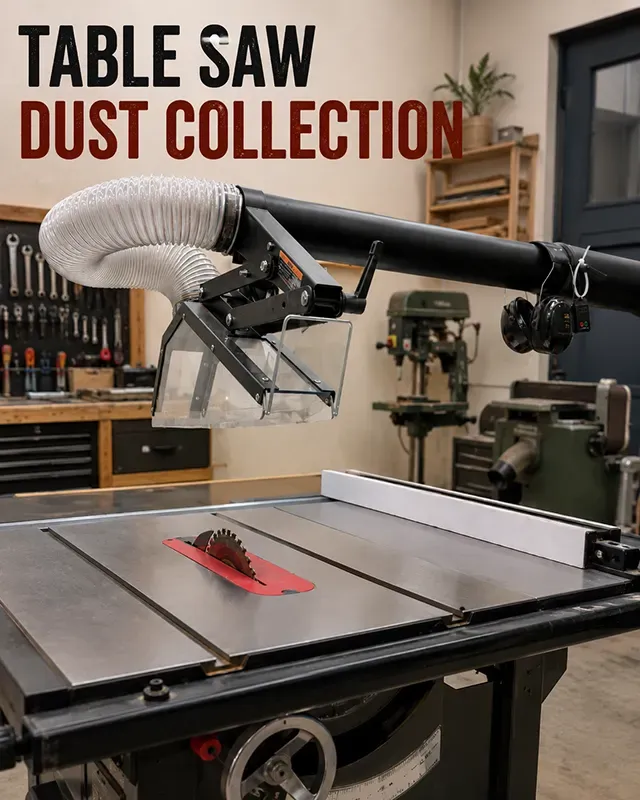
To address the fine dust thrown above the table, you need an overarm guard or a specialized blade guard with a built-in dust port (usually 2.5 to 3 inches) that hovers directly over the cut. While custom enclosures and ambient filters help, an overarm guard tied into your main dust system is the most direct mechanical solution for capturing fine dust before it goes airborne.
Seal the Cabinet Wisely
Many contractor saws and hybrid saws have open bases or large gaps around the elevation mechanics. A dust collector relies on controlled airflow. You can improve cabinet evacuation significantly by sealing the largest gaps using magnetic vent covers or baffles. However, be careful not to seal the cabinet completely airtight. The system needs “make-up air” to carry the dust away; if you choke off all incoming air, the airflow stops, and the dust simply settles inside.
Optimize the Internal Shroud
Some high-end cabinet saws employ an internal dust shroud that wraps directly around the lower half of the blade, funneling dust straight into the collection hose before it ever enters the main cabinet housing. If your saw has an internal shroud, ensure the flexible hose connecting the shroud to the exterior port is intact. Over time, these internal hoses can crack or detach from vibration.
Common Mistakes to Avoid
When setting up your system, avoiding basic aerodynamic errors is just as important as buying the right equipment. Long-term feedback suggests these are the most frequent causes of poor performance:
- Excessive Flex Hose: Corrugated flex hose creates significantly more static pressure resistance than smooth rigid pipe. Keep flex hose runs as short as absolutely necessary to connect the machine.
- Necking Down Main Lines: Avoid necking a high-CFM dust collector line down to a 2.5-inch port and expecting cabinet-saw performance. The small opening becomes the controlling restriction.
- Too Many Sharp Elbows: Using tight 90-degree plumbing elbows creates massive air turbulence. Always use long-sweep dust collection elbows or two 45-degree elbows spaced apart.
- Ignoring Filter Maintenance: A clogged filter drastically increases static pressure, dropping your CFM at the tool regardless of how powerful the blower motor is.
Before You Buy a Bigger Dust Collector, Run the Numbers
Before spending money on a larger dust collector, start with the airflow path you already have: port diameter, hose length, duct layout, elbows, filter condition, and whether the saw captures dust above the table. A bigger blower cannot fix every restriction downstream. Use the CFM Calculator to estimate what your system can realistically deliver at the table saw, then decide whether the weak point is the collector, the ductwork, the port size, or the capture method itself.