
Table Saw Dado Blades: Fit, Arbor Length, Throat Plates & Safety
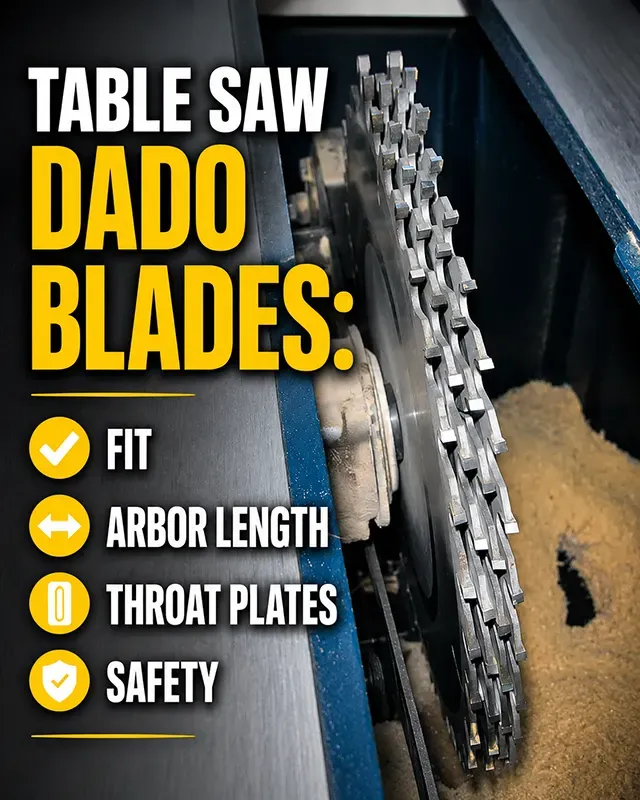
Adding a dado blade to a table saw fundamentally changes how the machine operates. Instead of slicing a 1/8-inch kerf through a board, you are asking the motor to clear a groove up to 13/16 inch wide in a single pass.
For joinery—cutting grooves, rabbets, and tenons—a dado set for a table saw is a highly efficient tool. However, the assumption that any circular blade fits any saw causes a lot of frustration and wasted money. Many modern saws are simply not engineered to accept a dado stack, and attempting to force one to fit is dangerous.
Before buying a dado set, confirm six things in this order: manual approval, maximum dado diameter, maximum stack width, arbor nut engagement, dado throat plate availability, and safety-system compatibility.
Can My Table Saw Use a Dado Blade?
Only if the manual explicitly allows stacked dado blades and lists the permitted diameter, maximum width, insert requirements, and safety-system requirements.
Do not rely on blade diameter alone. Some 10-inch portable saws support dado stacks to a limited width, while some compact saws do not support dado stacks at all. Accessory inserts also vary by model. For example, SKIL’s SPT99 dado insert is designed for stacked dados up to 13/16 inch, while other compact models may be limited to 1/2 inch or no dado use.
If the manual states dado blades are not supported, do not attempt to bypass the design limits.
The Arbor Length Limitation
The single most common point of failure when attempting to mount a dado stack table saw setup is the arbor length.
A traditional dado set consists of two outer blades and multiple inner chippers of varying thicknesses, plus magnetic or brass shims for fine-tuning. When fully assembled, this stack can measure up to 13/16-inch wide.
To mount this safely, the saw’s arbor must be long enough to accommodate the full stack and whatever washer/nut arrangement the manufacturer specifies. The nut must be fully engaged on the arbor threads. If the end of the arbor does not sit flush with or protrude slightly past the outer face of the nut, the setup is compromised. A nut holding a heavy, spinning mass by only two or three threads is a severe safety hazard.
Furthermore, you cannot simply remove standard washers to gain thread space unless the manufacturer explicitly instructs it. For instance, some Bosch manuals specify that if a dado stack is wider than 1/2-inch, you must remove the standard inner washer and use a specific accessory dado washer. The instruction limits the maximum stack to 13/16-inch to ensure complete nut engagement.
6-Inch vs. 8-Inch Dado Sets
If your saw can accommodate a dado stack, you must determine the correct diameter.
Cabinet saws and heavy-duty hybrid saws are more commonly designed around 8-inch dado sets, and their larger motors and heavier drivetrains usually tolerate the extra rotating mass better than compact jobsite saws.
For 120V jobsite saws, do not assume either 6-inch or 8-inch is automatically correct. The manual decides the allowed diameter and width. Mechanically, a 6-inch stack has less rotating mass and often places a lighter startup and cutting load on compact motors, especially for shallow grooves and rabbets. However, some 10-inch portable saws are specifically designed and documented for 8-inch dado sets up to a certain width. Always default to the maximum specifications listed in your machine’s documentation.
Dedicated Throat Plates
You cannot run a table saw dado blade with a standard throat plate. The factory plate is slotted for a 1/8-inch kerf, and the wider stack will immediately strike the metal or composite insert.
You must install a dado-specific throat plate. Manufacturers usually sell these as optional accessories, and their manuals often include explicit warnings against performing dado cuts without the correct insert installed.
If you build a custom zero-clearance dado insert from MDF or phenolic resin, ensure it sits perfectly flush with the table top. Because dado cuts are used for precision joinery, even a fraction of a millimeter of vertical deflection in the throat plate will result in an uneven depth of cut.
Brake Cartridge Compatibility (SawStop)
If you own a SawStop, the compatibility requirements are absolute. You cannot use a standard 10-inch brake cartridge with a dado set.
The standard brake cartridge is designed around a standard blade geometry, not the smaller diameter and wider profile of a dado stack. SawStop requires the dedicated dado brake cartridge for supported dado use.
SawStop recommends standard 8-inch stacked dado sets up to 29/32 inch thick and does not recommend wobble or Dial-A-Width dado sets, as their irregular profiles may not interact correctly with the aluminum brake pawl during an activation. Also, note that the SawStop Compact Table Saw does not support dado blades at all.
What a Dado Stack Is Not
A dado stack is not a normal blade upgrade. It changes cutter width, exposed mass, guard compatibility, insert clearance, and motor load.
It also does not replace router joinery in every case. For stopped dados, narrow grooves, plywood undersized grooves, or machines that do not support dado stacks, a router or multiple-pass table saw setup may be safer and more controllable.
Safety Checks and Feed Rates
Cutting with a table saw dado blade requires a shift in operating habits. Because you are removing significantly more wood, the physical resistance and kickback dynamics change.
- Riving Knife Protocol: Because dado cuts are non-through cuts, the normal blade guard and anti-kickback pawls usually cannot be used. Do not assume the riving knife should simply be removed on every saw. Follow the saw manual for the correct riving knife position. Some saws require the riving knife to be lowered, while others may require a non-through riving knife or a different setup.
- Rotate by Hand: Before powering the saw, rotate the dado stack by hand with the saw unplugged. Confirm that the cutters clear the throat plate, arbor washer, brake cartridge if applicable, and surrounding components.
- Workpiece Control: Never freehand a dado cut. The workpiece must be controlled by the fence, miter gauge, sled, or another approved guide system. For cross-dados made with a miter gauge or sled, do not trap the workpiece between the dado stack and the rip fence. Use a stop block positioned before the blade if you need repeatable length.
- Featherboards: Use featherboards where appropriate. One setup can keep the workpiece registered against the fence, while another can help maintain downward pressure. The exact arrangement depends on whether the dado is along the grain, across the workpiece, against the fence, or with a miter gauge.
- Feed Rate: Slow your feed rate. At the same depth of cut, a 3/4-inch dado removes roughly six times the kerf width of a 1/8-inch blade. Forcing the wood too quickly can cause burning, tear-out, motor bogging, and unnecessary strain on the motor bearings.
A dado stack is a high-value addition to a workshop, provided your saw is built to hold it and you follow the mechanical limits laid out by the engineers who designed the tool. Rely on your specific manual rather than workshop assumptions to confirm what your machine can safely handle.