Table Saw Blade Hook Angle Explained: Feed Rate, Grab, and Cut Control
When evaluating table saw blades, tooth count and grind profile usually get the most attention. However, hook angle—often called rake angle—fundamentally changes how a blade interacts with wood. It dictates the aggression of the cut, the physical resistance you feel while feeding the stock, and the likelihood of the blade grabbing the material.
Understanding hook angle is a matter of basic geometry, but its effects on the saw’s cutting dynamics are profound.
What is Hook Angle?
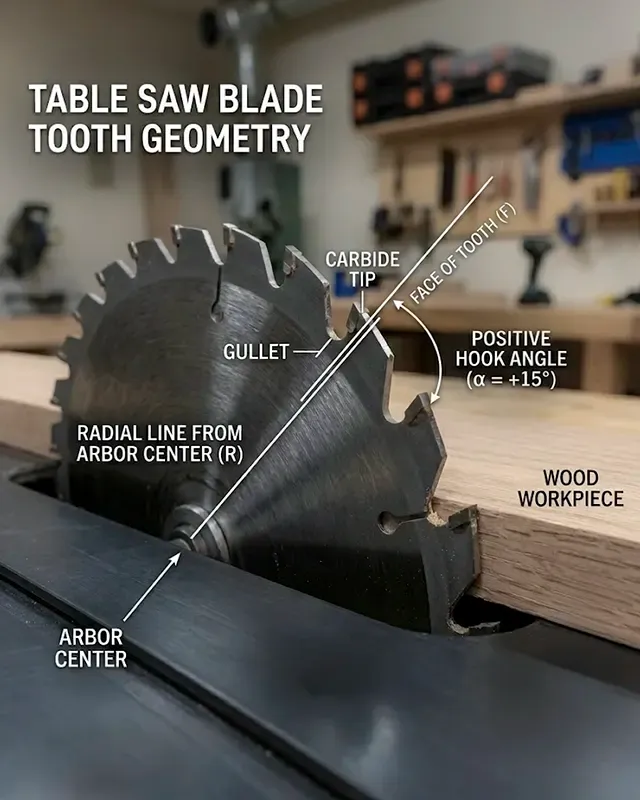
Hook angle describes the lean of the blade’s teeth. If you draw an imaginary radial line from the center of the arbor hole to the tooth’s cutting edge, hook angle is the deviation of the carbide face from that radial reference line.
If the top of the tooth leans forward, ahead of the center line, it has a positive hook angle. If it leans backward, behind the center line, it has a negative hook angle. If the tooth face aligns perfectly with the center line, the hook angle is exactly zero.
This angle determines how the carbide tip addresses the wood fibers: either lifting and digging under them, or pressing against them with a flatter approach.
High Positive Hook Angles: Aggressive Cutting
Most dedicated ripping blades feature a high positive hook angle, typically between 15° and 22°.
Because the teeth lean heavily forward, they bite into the wood fibers more aggressively and tend to self-feed more than a neutral or negative hook blade. Mechanically, this aggressive geometry allows the blade to clear large amounts of waste quickly. It reduces the resistance against the operator, meaning you do not have to push as hard to maintain a steady feed rate.
However, the tradeoff for speed is surface finish and grab. As the forward-leaning teeth exit the top of the cut, they tend to lift and tear the wood fibers rather than shearing them cleanly. This pulling action also means the blade is actively trying to feed the wood faster than the operator might intend. If the workpiece is not fully supported and controlled, this grabbing tendency can quickly lead to table saw kickback.
While a 20° positive hook rip blade can reduce operator fatigue and may reduce heat build-up by clearing chips efficiently, actual heat generation still depends heavily on your feed rate, blade sharpness, resin accumulation, and the species of wood being cut.
Low and Neutral Hook Angles: The Middle Ground
General-purpose and combination blades usually feature a moderate positive hook angle, hovering between 5° and 15°.
This geometry attempts to balance the easy feed rate of a ripping blade with the clean shearing action required for crosscutting. A 10° hook angle is aggressive enough to rip hardwood without drastically overloading the saw’s motor, but upright enough to minimize severe tear-out when cutting across the grain. For most small shops leaving one blade in the saw, this moderate angle provides the most practical versatility.
Negative Hook Angles: Control and Cleanliness
Blades with negative hook angles, usually between -2° and -7°, lean away from the direction of rotation.
Instead of digging into the wood and pulling it forward, a negative hook angle reduces the tooth’s tendency to pull itself into the workpiece. The cutting action becomes closer to a controlled scraping or shearing action than an aggressive chiseling action.
While high feed resistance sounds like a drawback, it is often a mechanical requirement for certain setups and materials:
- Sliding Miter Saws and Radial Arm Saws: For crosscutting on sliding miter saws and many radial arm saw setups, negative or zero hook angles are the standard recommendation. Because the blade is pulled across the wood on these machines, a positive hook angle can cause the saw to self-feed, violently climbing the workpiece toward the operator. A negative hook helps reduce self-feeding and helps keep the workpiece seated firmly against the table and fence.
- Brittle Sheet Goods: Negative or very low hook angles are often used in blades intended for delicate veneers or melamine on a table saw. By engaging the material less aggressively, they help minimize chipping. However, a negative hook angle does not guarantee a clean cut on its own; it works together with a high tooth count, specific grind geometry (like Hi-ATB or TCG), a zero-clearance insert, and steady feed technique.
- Non-Ferrous Metals: Negative hook or very low hook blades are commonly used for cutting non-ferrous metals such as aluminum and brass. The negative angle helps reduce the teeth’s tendency to grab the softer metal, which could otherwise stall the motor or throw the workpiece. On a table saw, feeding material into a negative hook blade usually just feels slower and requires more deliberate, continuous pushing force from the operator.
Hook Angle vs. Tooth Grind: They Are Not the Same Thing
It is common to confuse hook angle with tooth grind, but they control entirely different aspects of the cut.
- Hook Angle is the forward or backward lean of the tooth face. It primarily controls feed rate, grab, and how aggressively the blade addresses the wood.
- Tooth Grind (such as Flat Top Grind, Alternate Top Bevel, or Triple Chip Grind) refers to the shape of the top edge of the carbide tooth. It primarily dictates how the fibers are severed (sheared vs. chiseled) and the shape of the kerf bottom.
You can have a steep 20° positive hook angle combined with a Flat Top Grind (standard for fast ripping), or a -5° negative hook angle combined with an Alternate Top Bevel (standard for sliding miter saws). Recognizing that these are independent variables helps you understand why a manufacturer designed a specific blade the way they did.
Typical Hook Angle Ranges by Blade Type
While exact specifications vary by manufacturer (like Freud, Amana, or Forrest), hook angles generally fall into predictable ranges based on their intended use:
| Blade Type | Typical Hook Angle | Cutting Characteristics |
|---|---|---|
| Rip Blades | 15° to 22° | Fast feed rate, low feed pressure, aggressive grab. |
| General Purpose / Combination | 5° to 15° | Balanced feed rate, moderate finish, versatile. |
| Fine Crosscut / Plywood | 0° to 15° | Slower feed, cleaner exit, varies heavily by saw type, tooth count, and grind. |
| Sliding Miter / Radial Arm (Crosscut) | 0° to -7° | Resists self-feeding, helps push work against the fence. |
| Non-Ferrous Metals (Aluminum) | -2° to -7° | Reduces grabbing, requires slow and deliberate feed. |
Safety Note: Hook Angle Does Not Replace Setup
While selecting a blade with a less aggressive hook angle can change the feel of the feed and reduce the blade’s tendency to self-feed, it is not a substitute for proper machine setup.
A negative hook angle will not prevent kickback if the fence is out of parallel, and a moderate combination blade will still throw a workpiece if it binds against the back of the blade. Regardless of the hook angle mounted on the arbor, safe table saw operation requires a properly aligned fence, an installed riving knife or splitter, appropriate push blocks, and adequate outfeed support. The blade’s geometry simply changes how the tool addresses the wood; you still have to manage the mechanics of the cut.