
Table Saw Blade Cleaning: Resin Buildup, Heat, and Cut Quality
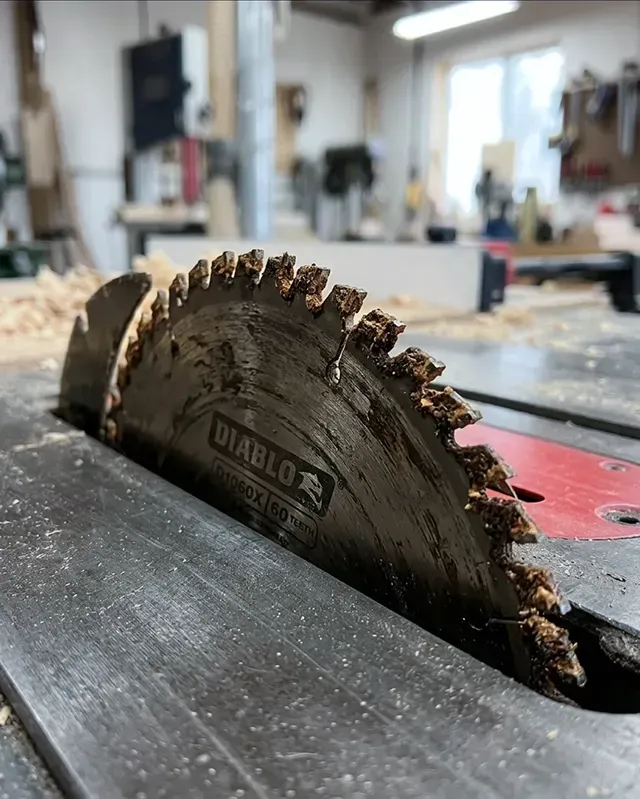
There is a distinct moment in a table saw blade’s lifespan when the tool starts to fight back. The saw begins to bog down under load, the wood requires more physical force to push past the riving knife, and boards emerge with dark, scorched edges.
The immediate assumption is usually that the tungsten carbide teeth have finally dulled and the blade needs to be replaced or sent to a sharpening service. But very often, especially after cutting resinous softwoods or sheet goods, the blade is not truly worn out yet. It may simply be dirty.
To understand why a dirty blade behaves exactly like a dull blade, we have to look at how pitch buildup mechanically changes tooth clearance, friction, and heat.
The Mechanics of Pitch Buildup
Wood is not just cellulose fiber; it is packed with moisture, sap, resins, and lignins. Softwoods like pine, fir, and spruce are particularly resinous, and sheet goods are heavily reliant on synthetic glues.
When a table saw blade spins at roughly 4,000 RPM, it generates friction. That friction produces heat, which softens the natural resins and glues in the material. As the teeth leave the cut and cool, softened resin can harden onto the steel plate and carbide surfaces. Over a few dozen cuts, this creates a hard, amber-colored crust known as pitch.
Mechanically, this pitch buildup interferes with the geometry the blade depends on.
How Resin Alters Tooth Geometry
A modern table saw blade does not simply plow through wood. Each carbide tooth is ground with precise angles. The front of the tooth (the rake angle) handles the aggressive lifting of the wood fiber, but the top and sides of the tooth feature a clearance angle.
This relief angle tapers away from the cutting edge so that only the very tip of the carbide actually touches the wood.
When pitch builds up around the tooth face, side clearance, and gullet area, it reduces the free space that normally keeps the steel and carbide from rubbing the kerf. Instead of a sharp edge slicing through the material with minimal contact, a wide, sticky, resin-coated surface is now dragging aggressively against the sides of the cut.
The Heat Feedback Loop
Once the clearance angle is compromised by resin, a destructive mechanical cycle begins:
- Increased Surface Area: The resin-coated tooth rubs against the wood, drastically increasing surface friction.
- More Heat: That friction generates excessive heat, which causes the wood to scorch and burn.
- Faster Accumulation: The newly elevated blade temperature softens even more resin from the wood, accelerating the buildup.
- Thermal Expansion: If heat becomes severe enough, the steel plate can expand unevenly. That can contribute to blade distortion, a rougher kerf, more vibration, and higher feed resistance.
When a woodworker feels resistance and assumes the blade is dull, what they are actually feeling is the physical friction of baked resin dragging against the wood.
Chemical Breakdown: The Oven Cleaner Debate
Removing baked-on pitch usually requires softening the resin chemically before brushing it away. While many dedicated blade cleaners exist, shop owners have spent years debating the best solvents.
A common, cheap workaround discussed in workshops and forums is standard oven cleaner. It is aggressive, fast, and dissolves pitch in seconds. However, blade manufacturers and sharpening services strongly advise against it for a specific mechanical reason.
Most oven cleaners contain sodium hydroxide (lye). Lye is highly caustic. While it will not harm the steel plate itself, it may chemically attack or weaken the brazing—the silver and copper alloy used to weld the carbide teeth to the steel body. Over time, repeated exposure to strong alkaline caustics can weaken the braze joint.
Dedicated pitch removers, citrus-based cleaners, and non-caustic degreasers are the safer default because they are intended to soften pitch without relying on strong alkaline chemistry. Always follow the blade manufacturer’s cleaning guidance first, and do not soak coated blades longer than the cleaner label recommends.
The Cleaning Process
Restoring the blade’s geometry requires chemical soaking and mechanical agitation. The process is straightforward:
- Prep and Safety: Remove power first: unplug the saw, remove the blade, and handle the carbide teeth with gloves or a rag.
- Soak: Place the blade in a shallow pan (a plastic trash can lid works well) and coat the teeth generously with a safe degreaser or pitch remover. Let it sit for 10 to 15 minutes to allow the chemicals to soften the hardened resin.
- Scrub: A brass or stiff nylon brush is safer around carbide edges than a steel wire brush. The goal is to remove softened pitch, not scrape the cutting edge aggressively.
- Rinse and Dry: Rinse the blade with water and dry it immediately. Leaving water on the steel plate will cause flash rust within hours.
- Protect: Apply a dry lubricant or rust inhibitor (like Boeshield T-9 or a light coat of paste wax) to the steel plate. Avoid heavy oils that will just attract sawdust.
Determining True Wear
Only after a blade is completely stripped of pitch can you assess its actual sharpness.
If you clean a blade, reinstall it, and it still requires excessive feed pressure or leaves burn marks, the carbide is likely dull. If you inspect the carbide teeth under a magnifying glass and see a rounded edge catching the light, or tiny chips missing from the corners, it is time for a professional sharpening or a replacement.
Based on typical long-term ownership feedback, a standard carbide blade used in a hobbyist or small shop environment can often run for a surprisingly long time before genuinely losing its edge—provided the clearance angles are kept free of resin.
When to clean: If feed pressure increases, burn marks appear on wood that previously cut cleanly, or the blade leaves more fuzz and heat than usual, cleaning should come before sharpening or replacement. Cleaning will not fix chipped carbide, missing teeth, warped plates, or a blade that has already lost its cutting edge.