
Rip Blade vs Crosscut Blade: Teeth, Gullets, and Cut Quality
INFO
Evidence Level: Level 0 — Theory Lab.
Table saw blades look remarkably similar from a few feet away, but their mechanical designs are meaningfully different. A common cause of poor cut quality is not the saw itself, but a mismatch between blade geometry and cut direction. To understand why table saw blades perform the way they do, you have to look closely at tooth geometry and gullet capacity. For a broader breakdown of tooth count, kerf, hook angle, and grind geometry, start with our table saw blades explained guide.
Wood grain behaves like a bundle of long fibers. Cutting parallel to those fibers requires a different mechanical action than severing them across their width.
The Mechanics of a Rip Blade
When you rip a board, you feed the wood parallel to the grain. In this orientation, the saw blade acts less like a knife and more like a rapid series of chisels carving out wood.
This operation tends to generate long, continuous chips quickly, especially in thick hardwood.
Tooth Count and Gullet Capacity
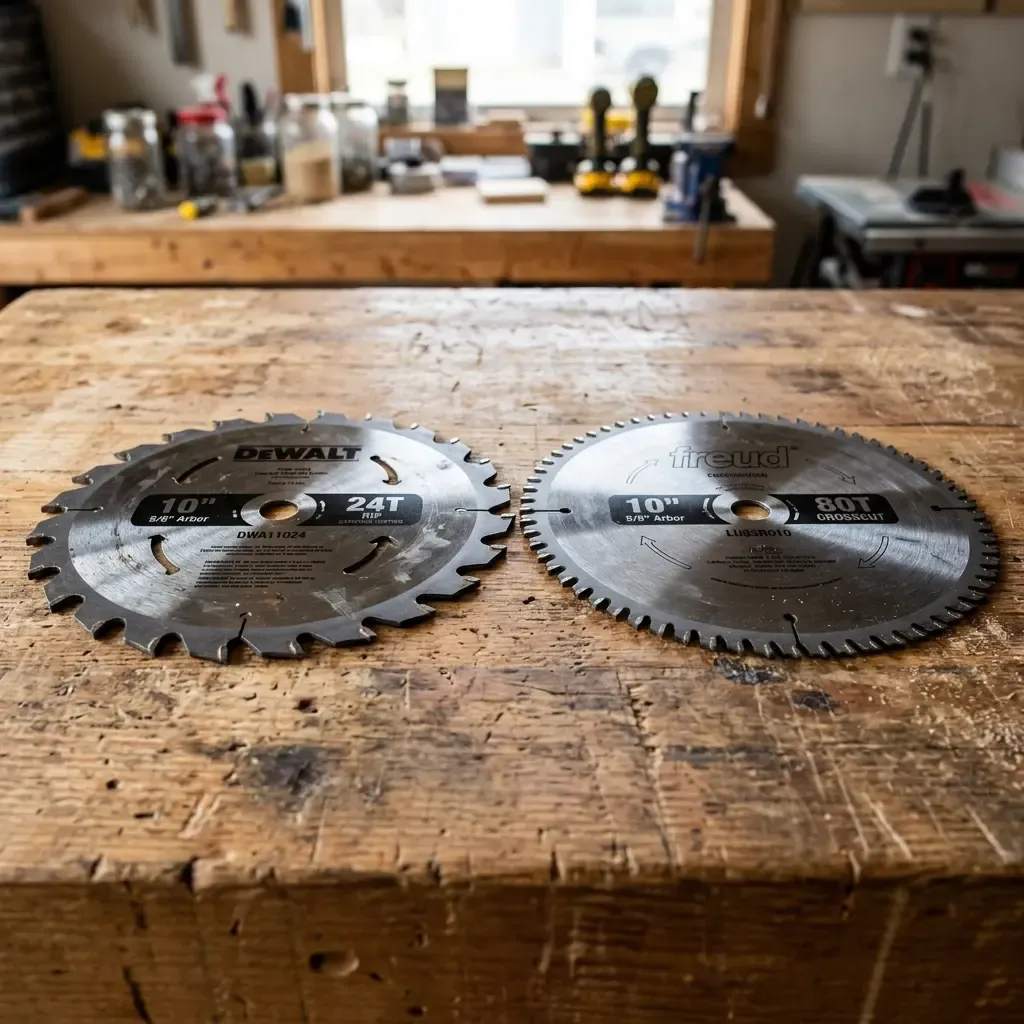
Rip blades typically have between 24 and 30 teeth. Because there are fewer teeth along the perimeter, the physical gaps between them—called gullets—are relatively deep.
Deep gullets are especially important when ripping thicker stock. They act as evacuation chambers, carrying long, stringy chips out of the kerf before heat and friction build up.
Hook Angle and Grind (FTG)
Rip blades often use a more aggressive positive hook angle to help feed the wood steadily along the grain with less feed resistance.
Many dedicated rip blades use a Flat Top Grind (FTG), especially those intended for fast ripping. The top edge of the carbide tooth is flat and square to the blade body. This shape chisels through the wood fibers and can leave a flatter-bottom kerf than ATB teeth, though the actual smoothness of the bottom will still depend on arbor runout and plate stiffness. However, because it attacks the wood more bluntly than an ATB tooth, an FTG tooth is more likely to cause splintering across the grain.
The Mechanics of a Crosscut Blade
Crosscutting means severing the wood fibers across their width. If you use a blunt, chisel-like tooth here, the unsupported fibers will simply splinter and tear. Instead, the blade needs to act like a precision knife, scoring the delicate outer fibers before removing the center waste.
Tooth Count and Gullet Capacity
Fine crosscut blades commonly use 60 to 80 teeth. Because the teeth are packed more closely together, the gullets are intentionally shallow.
Since crosscutting generally produces shorter, finer chips than ripping, the blade does not need the same gullet volume. The high tooth count means each individual tooth takes a smaller bite of material, reducing tear-out on the exit side of the cut.
Hook Angle and Grind (ATB)
To control that bite and reduce tearing, fine crosscut blades generally use a less aggressive hook angle than rip blades.
Instead of a flat top, crosscut teeth are ground at a steep angle. The teeth alternate—one bevels to the left, the next bevels to the right. This geometry is known as an Alternate Top Bevel (ATB) or High-ATB. This alternating pattern scores the edges of the cut cleanly, slicing the wood fibers on both the left and right sides before the center material is cleared out, leaving a cleaner surface.
What Happens When You Swap Them?
Understanding these design limits explains why mismatching the blade to the task causes ownership friction.
Ripping with a crosscut blade: If you feed a long hardwood board into an 80-tooth crosscut blade, the shallow gullets quickly pack full of long wood fibers. The dust has nowhere to go, so it rubs against the wood inside the kerf. This friction creates thermal build-up, which leaves dark burn marks on your edges. More importantly, the clogged blade slows the feed rate, taxes the motor, and forces the user to push harder. Pushing hard on a bound board increases the risk of the wood twisting away from the fence and triggering a table saw kickback. Using thin-kerf vs full-kerf blades can also impact motor load here, but neither will save a crosscut blade tasked with a heavy rip.
Crosscutting with a rip blade: If you crosscut plywood or hardwood with a 24-tooth FTG blade, the flat teeth will aggressively punch through the cross-grain. With no slicing or scoring action to protect the surface fibers, the blade tears the grain apart, leaving jagged edges on the exit side of the cut.
The General-Purpose and Combination Compromise
For many small shop owners, swapping blades for every single cut creates setup friction. This is where compromise blades step in.
Manufacturers do not always use these labels consistently, but mechanically the two common compromise patterns are different.
- General-Purpose Blades (40T): These typically feature an ATB grind with a moderate hook angle, designed to crosscut reasonably well while leaving enough gullet space to handle light ripping.
- Combination Blades (50T): These usually feature a grouped tooth design—often four ATB teeth followed by a flat raker tooth (ATB-R), with a deeper gullet placed between the groupings to clear chips more effectively during rip cuts.
While a high-quality 40T or 50T blade can handle most general workshop tasks admirably, it remains a mechanical compromise. It will not rip thick 8/4 hardwood with as little feed resistance as a dedicated 24T rip blade, nor will it usually leave the cleaner veneer or plywood edges expected from a sharp 80T crosscut or plywood blade.
This is why hunting for a single best table saw blade is often a flawed approach. The ideal cut quality does not come from a single universal disc; it comes from matching the correct tooth geometry to the correct feed direction.