
Portable Table Saw Stand Types: Folding, Rolling, and Gravity-Rise
INFO
Evidence Level: Level 1 — Document Lab + Mechanical Analysis + Owner Feedback
Evidence: Manufacturer specifications, mechanical design analysis, and owner feedback.
A table saw is inherently dangerous when unstable. If you push a heavy sheet of plywood through the blade, you apply forward and lateral force to the machine. If the stand shifts, racks, or tips during that cut, the resulting loss of control can increase the risk of binding or kickback.
For jobsite contractors and small garage woodworkers, bolting a heavy cabinet saw to the floor is not an option. You need a portable table saw stand. However, increasing mobility usually introduces additional wheels, pivots, folding joints, or a narrower support geometry, so stand design involves a tradeoff between transport convenience and deployed stability. Manufacturers solve this compromise through several distinct mechanical designs, each with its own tradeoffs in storage footprint, setup effort, and vibration control.
Fixed-Leg Bases
The most basic stand is a fixed-leg assembly, often made of thin stamped steel or tubular aluminum, with splayed legs and rubber feet.
Mechanically, a fixed stand prioritizes cutting stability over setup ease. Because the frame has fewer moving joints, it has fewer mechanical interfaces that can introduce play. The splayed legs create a wide base that effectively resists tipping under lateral load.
The tradeoff is mobility. Moving a fixed stand requires either dragging it across the floor, which can wear the rubber feet and makes repositioning cumbersome, or lifting the entire assembly. For a lighter compact saw, this may simply be inconvenient. For a heavier jobsite saw, repeatedly lifting the entire assembly becomes a more significant setup barrier. This design makes the most sense if your saw lives in one corner of a dedicated shop and rarely moves.
Scissor-Folding Stands
Scissor stands use an X-frame design with a central pivot. When folded, the saw and frame collapse toward a lower, flatter position against the underside of the saw body. Some models include small caster wheels on one end, allowing you to wheel the collapsed saw like a piece of luggage.
The primary advantage of a scissor stand is its incredibly low storage profile. If you need to slide a saw under a workbench or store it in the back of a small SUV, a scissor stand consumes the least vertical space.
The primary limitation of this design is the setup friction and potential for flex. Depending on the design, erecting a scissor stand can require lifting or repositioning much of the saw’s weight before the frame locks into place. Furthermore, the central pivot also introduces another mechanical joint that can become a potential source of play as hardware, bushings, or joints wear. The practical effect depends heavily on the stand’s construction and maintenance.
Wheelbarrow-Style Stands
The wheelbarrow design features two fixed wheels at the rear and two folding legs at the front. To move the saw, you collapse the front legs, grab the extendable handles, and wheel it around.
This design offers a strong middle ground. When the front legs are deployed and locked, the support points are transferred from the wheels to the stand’s feet, reducing the role of the wheels during cutting. Larger wheels generally reduce the angle and force required to roll over small thresholds, cords, gravel, and other surface irregularities compared to the tiny luggage wheels found on scissor stands.
However, long-term ownership feedback frequently points out a storage tradeoff. Because the handles and rear wheels remain part of the deployed geometry, some wheelbarrow-style stands retain a relatively large horizontal footprint when stored. If you are optimizing a tight garage layout, a wheelbarrow stand may consume too much valuable floor space.
Gravity-Rise and Rolling Cart Stands
Gravity-rise and rolling cart designs are widely used on portable and jobsite saws because they combine wheels, folding geometry, and a relatively stable deployed base. These designs solve the same basic problem: allowing a heavy saw to transition between a compact storage position and a supported cutting position without requiring the user to carry the entire saw.
Gravity-rise stands use a linkage and pivot system that changes the geometry of the stand as the saw moves between its storage and working positions. The mechanism is designed to reduce the manual lifting effort required during setup rather than simply relying on the user to lift the entire saw vertically. Bosch’s TS2100 is a clear example of this approach, using 8-inch wheels and heavy-gauge steel-tube construction. Bosch also specifies the stand for up to 250 lb of downward force.
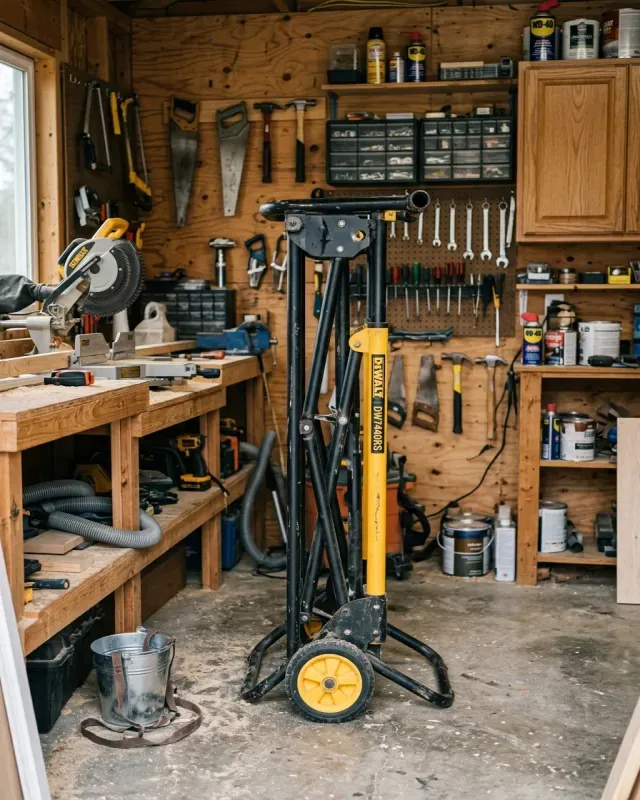
Other rolling stands, including DeWalt DWE7491RS’s included DW7440RS, achieve portability through folding legs, large wheels, and a kickstand rather than using Bosch’s Gravity-Rise mechanism.
The deployed frame uses a wider support geometry than the folded storage position. The wider support geometry can increase the tipping margin by placing the support points farther from the machine’s center of mass. That wider stance can improve resistance to tipping, but it also increases the floor area required during cutting. A stand can have a compact storage profile without being compact during use. Owner feedback on rolling DeWalt stands, for example, includes praise for portability and stability but also notes that the deployed stand can consume substantial floor space in a small shop.
Mounting Compatibility
A portable stand is only useful if the saw can be mounted securely without compromising the manufacturer’s mounting requirements. Universal compatibility should therefore be treated as a mounting-interface claim, not simply a claim that the stand can physically support another saw.
Stand manufacturers handle this differently. Bosch’s TS2100 provides mounting holes for several competing saw brands, while DeWalt publishes model-specific compatibility and adapter requirements for its stands. Makita also claims broad compatibility, though mounting methods vary. Do not assume that a stand’s physical capacity makes it compatible with a particular saw. Follow the stand manufacturer’s specified mounting method and adapter requirements rather than modifying the frame yourself. Always verify the exact saw model, mounting-hole pattern, required brackets, and the stand manufacturer’s approved configuration before mounting a saw.
The Footprint vs. Mobility Decision
Choosing the right stand comes down to how frequently you move the saw and what kind of terrain you move it across.
If you regularly move a saw across gravel, thresholds, or other uneven surfaces, a useful starting point is to compare wheel diameter, wheel construction, and deployed frame geometry. Wheel diameter matters because larger wheels roll over surface irregularities with less resistance, while the frame geometry determines how stable the saw remains once positioned.
If you work in a basement shop and only pull the saw away from the wall to make long rip cuts, a fixed-leg configuration or a simple wheelbarrow-style design may provide a smaller deployed operating footprint.
Before committing to a specific stand design or a saw bundled with one, consider both the folded and operating footprint to ensure the machine actually fits your workflow when fully deployed.