
Kerf Explained: What It Means for Table Saw Blades
NOTE
Definition Note: Evidence Level 0 — Theory Lab
This glossary entry explains the term “kerf” using blade geometry, manufacturer specifications, and table saw safety principles. It does not include physical blade testing.
Kerf Explained: What It Means for Table Saw Blades
When a board passes through a table saw, a portion of the wood is pulverized into sawdust. The width of that missing material—the actual physical slot cut into the workpiece—is known as the kerf.
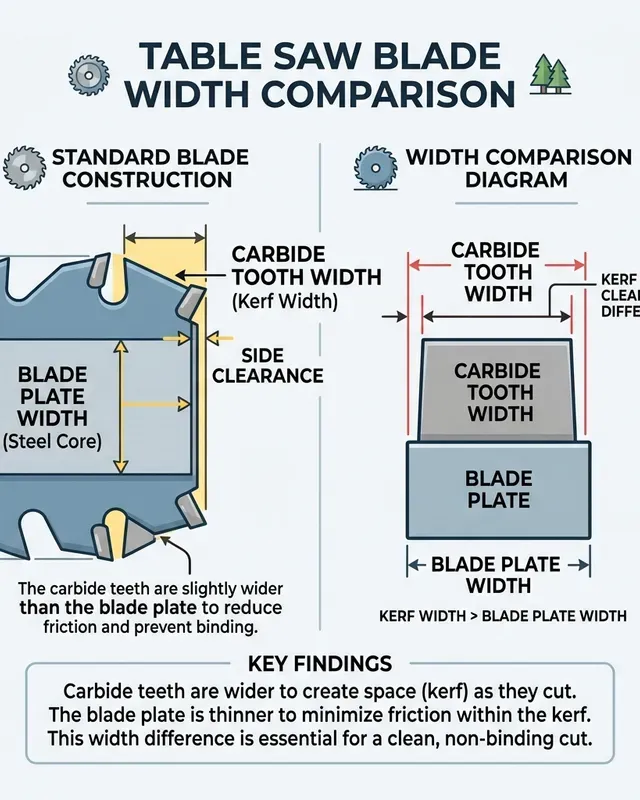
On most modern carbide-tipped table saw blades, the kerf is determined by the widest part of the teeth, usually the carbide tips, not by the thickness of the steel blade plate.
Understanding kerf is a basic requirement for choosing and setting up a table saw blade. The width of the blade dictates how much power your saw needs to complete a cut, how much material is converted to waste, and—most importantly—whether your riving knife functions safely.
The Riving Knife Compatibility Rule
The most critical factor when discussing kerf is its relationship with the saw’s riving knife. The riving knife is the curved piece of metal sitting directly behind the blade, designed to prevent the wood from pinching shut and causing kickback.
OSHA safety principles for spreaders and riving knives dictate a very specific mathematical window for this safety device. To operate correctly, the riving knife must satisfy two conditions simultaneously:
- It must be thinner than the kerf of the teeth.
- It must be thicker than the blade plate.
DANGER
Safety Warning: If the riving knife is thicker than the kerf, the cut slot will be too narrow for the wood to pass. The workpiece will bind against the knife, requiring the operator to dangerously force the board through the saw.
Conversely, if the riving knife is thinner than the steel plate, it cannot effectively hold the cut open if the wood grain releases tension and pinches inward.
Some jobsite saws specify a minimum blade kerf and maximum blade body thickness for the supplied riving knife. Before installing a new blade, operators must consult their saw’s manual and verify that the riving knife’s stamped range matches the new blade’s kerf and plate thickness.
Plate Thickness vs. Tooth Width
To understand how blades behave under load, it is necessary to separate the concept of “kerf” from “plate thickness.”
For most North American table saws, blades fall into two broad categories:
- Full Kerf: Usually measures roughly 1/8” (0.125 inches) at the teeth.
- Thin Kerf: Usually measures roughly 3/32” (0.094 inches) at the teeth.
Full kerf blades often use a thicker plate than comparable thin-kerf blades. That added stiffness can help the blade resist lateral movement under load, which may support more consistent cuts on powerful saws. A thinner plate, while lighter, is mechanically more susceptible to deflection if it encounters dense grain, lateral pressure, or excessive heat buildup.
Mechanics of Motor Load
While the dimensional difference between 1/8” and 3/32” seems minimal, a full kerf blade removes approximately 33% more material than a thin kerf blade.
This difference translates directly to motor strain. Pushing a 1/8” wide path through a thick piece of hard maple requires significantly more energy than pushing a 3/32” path.
Mechanically, a thin kerf blade asks the motor to remove less wood per pass, so it can be a better match for lower-powered saws. By reducing the volume of wood being converted to sawdust, the blade can help a smaller motor maintain RPM more easily, which may make feed control more predictable.
The General Rule for Kerf Selection
As a simple rule: lower-powered 120V saws usually benefit from thin kerf blades, while higher-powered cabinet saws can usually take advantage of full kerf stability. In both cases, the saw manual and riving knife compatibility matter more than the label on the blade package.
Related Terms
- Kerf
- Blade plate
- Thin kerf
- Full kerf
- Riving knife
- Blade deflection