
FTG vs ATB vs TCG: Table Saw Tooth Geometry Explained
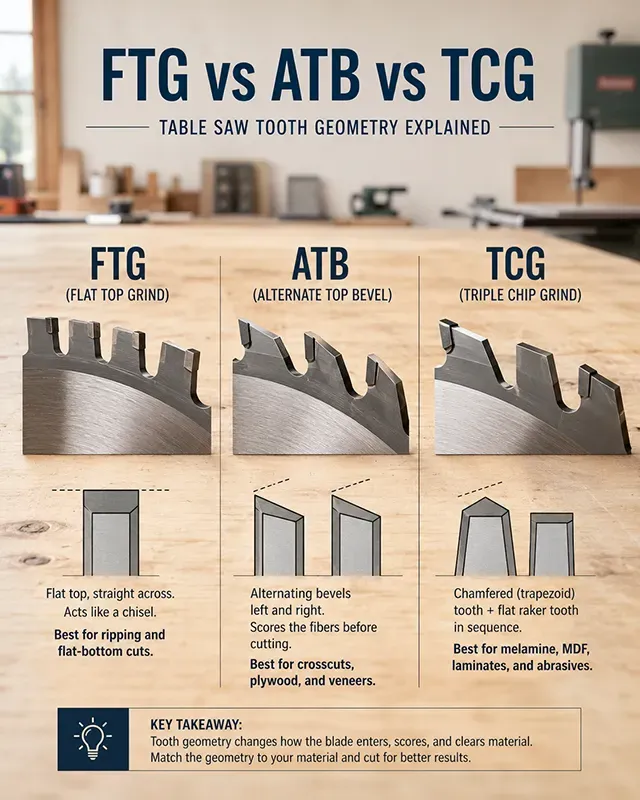
When evaluating table saw blades, tooth count and kerf width are usually the first metrics buyers look at. However, the shape of the carbide teeth—the tooth geometry—has a direct mechanical impact on how the blade enters, scores, and clears material.
Changing the geometry changes how the carbide interacts with wood fibers. It determines whether a blade shears the fibers cleanly, chisels them out aggressively, or distributes the load to survive abrasive materials. The three most common geometries are Flat Top Grind (FTG), Alternate Top Bevel (ATB), and Triple Chip Grind (TCG).
Understanding how these grinds work mechanically makes it easier to select the right tool for a specific cut, explaining why a blade that performs perfectly on solid maple might struggle with melamine.
FTG: Flat Top Grind
The Flat Top Grind is exactly what it sounds like. Every tooth is ground perfectly flat across the top, perpendicular to the blade plate.
Mechanically, an FTG tooth acts like a chisel. It attacks the wood head-on, hogging out material with each rotation. This geometry is almost exclusively used on dedicated rip blades.
Strengths:
- Efficiency: Because it acts like a chisel, it excels at cutting parallel to the wood grain. On dedicated rip blades, FTG geometry is usually paired with lower tooth counts and deeper gullets. That combination gives chips more room to exit the kerf, which can reduce heat and motor load during long rip cuts.
- Flat-Bottomed Cuts: FTG blades are the blade geometry most associated with flat-bottomed kerfs. If you are cutting grooves, a dado without a dedicated dado stack, or fine-tuning your box joint spacing, an FTG profile is better suited to leaving a square-bottomed cut than a pure ATB blade.
Tradeoffs:
- Tearout: When cutting across the grain (crosscutting), the chisel action of the FTG tooth is highly destructive. It punches through the unsupported fibers at the exit point of the cut, often causing heavy tearout.
- Feed Friction: Because the cutting edge is square rather than beveled, FTG does not pre-score the kerf edges the way ATB does. In thick hardwood, that makes feed rate, gullet capacity, and saw power more important.
ATB: Alternate Top Bevel
The Alternate Top Bevel design angles the top edge of the carbide. The bevels alternate sequentially: one tooth angles to the left, the next angles to the right.
While FTG teeth act like chisels, ATB teeth act like knives. The high point of the bevel makes initial contact with the wood, scoring the outer fibers before the rest of the tooth clears the waste.
Strengths:
- Clean Crosscuts: That scoring action is critical for crosscutting. By severing the fibers cleanly at the edges of the kerf before removing the bulk of the material, ATB blades can significantly reduce tearout.
- Plywood and Veneers: ATB and Hi-ATB profiles are common choices for plywood and veneered sheet goods, especially when the goal is cleaner top-surface fiber scoring. For abrasive laminates and production melamine work, many blades move toward Hi-ATB or TCG-style geometries depending on whether the priority is chip-free edges or edge life.
Tradeoffs:
- Non-Flat Kerf Bottoms: Because the cutting tips alternate left and right, a pure ATB blade can leave a slightly ridged or V-shaped kerf bottom rather than a clean flat-bottomed groove.
- Wear Patterns: The sharp, pointed tips of an ATB blade handle the brunt of the cutting friction. Mechanically, sharp points are fragile. ATB blades typically dull faster than FTG or TCG blades and require more frequent sharpening.
TCG: Triple Chip Grind
The Triple Chip Grind is a specialized geometry designed for durability rather than pure cut quality in natural wood. It uses a repeating two-tooth sequence.
Mechanically, this divides the cutting labor. The taller chamfered tooth removes the first portion of the kerf while avoiding fragile sharp outside corners. The slightly lower flat raker follows to square up and clear the remaining material.
Strengths:
- Durability: TCG is engineered to survive abrasive materials. MDF, melamine, plastics, laminates, and non-ferrous metals are punishing on sharp carbide points. By chamfering the corners of the primary cutting tooth, the TCG design eliminates the fragile sharp tips found on ATB blades. The impact force is distributed over a wider, blunter area, helping extend the time between sharpenings.
- Dense Materials: The staged cutting action can reduce the chance of carbide edge damage when cutting dense composites, abrasive glue lines, or hard inclusions.
Tradeoffs:
- Natural Wood Performance: On natural wood crosscuts, TCG usually does not sever long wood fibers as cleanly as a sharp ATB or Hi-ATB profile. It may leave more visible edge damage on delicate solid-wood crosscuts, even though it can be very effective on abrasive sheet goods and production panel materials.
- Sharpening Complexity: Because it features a complex two-tooth alternating profile with different heights and chamfers, sharpening a TCG blade requires precise grinding equipment, which can occasionally increase the cost of maintenance.
Geometry Comparison at a Glance
| Grind | Cutting Action | Best Fit | Weakness |
|---|---|---|---|
| FTG | Chisels and clears | Ripping, flat-bottom grooves | Crosscut tearout |
| ATB | Scores and shears | Crosscuts, plywood, veneer | Point wear, non-flat kerf bottom |
| TCG | Chamfer + raker staged cut | Melamine, MDF, laminate, plastics, abrasive materials | Usually less clean on natural wood crosscuts than sharp ATB |
Making the Choice
The mechanical differences between these grinds dictate their practical application in the shop.
If you are ripping large volumes of rough lumber or cutting flat-bottomed joinery, an FTG blade is usually the more mechanically appropriate choice. If your work involves crosscutting hardwoods or breaking down high-quality hardwood plywood, the scoring action of an ATB blade is required to manage tearout. If you are processing sheet after sheet of abrasive MDF or melamine, the more durable staged-cutting pattern of a TCG blade may extend edge life compared with sharper, more fragile ATB points.
For general use, many combination blades use an ATBR-style sequence: several ATB teeth followed by a flat raker tooth. This balances tearing resistance with a relatively flat bottom. It will not rip as efficiently as a dedicated FTG, nor will it leave crosscuts quite as flawless as a high-tooth-count ATB, but it serves as a highly functional mechanical compromise for a one-blade shop.