
First Table Saw Buying Guide: What Matters Before Brand or Price
NOTE
Evidence Level: Level 0 — Theory Lab + Buying Framework
This guide explains first-table-saw selection using machine design, safety principles, and common setup requirements. It does not rank specific table saw models or report physical test results.
This guide may include retailer links, but the buying logic starts with machine design, safety features, and setup requirements rather than brand preference.
Buying a beginner table saw usually triggers a lot of anxiety. For many new woodworkers, it is the loudest and most intimidating machine they bring into a small shop, and it has real injury risks if the fence, blade, guard, and feed technique are misunderstood. Because of this, buyers often focus heavily on table saw brands, assuming a familiar logo guarantees a good experience.
Most beginner table saw mistakes happen before the model comparison even starts. Brand loyalty will not help you if the fence will not lock straight or the table is too small to support your materials.
Before looking at specific models or hunting for a sale, it helps to understand how these machines actually work, what causes them to fail at basic tasks, and which mechanical tradeoffs make sense for your specific workshop.
First Question: Do You Actually Need a Table Saw First?
A common pattern in woodworking forums is new hobbyists buying a miter saw first, assuming it is safer and easier to use. If you are doing framing, decking, or installing baseboards where you primarily need to crosscut long boards to length, a miter saw usually makes more sense.
However, a miter saw cannot perform a rip cut—cutting a board lengthwise along the grain to make it narrower.
If you want to build furniture, cabinets, boxes, or repeatable shop projects, a table saw is usually the more practical first stationary saw because it handles the dimensioning work a miter saw cannot do. It handles repeatable rip cuts and controlled crosscuts using a standard miter gauge or a dedicated crosscut sled.
The Four Realistic Table Saw Categories
When looking for a good table saw for home use, you will generally choose between four categories based on weight, motor type, and structural design.
Portable / Jobsite Saws
Designed for construction sites, these are lightweight and usually feature an aluminum top. Most jobsite saws use direct-drive universal motors. They are compact and powerful for their size, but they tend to be louder and transmit more vibration than heavier induction-motor saws. They are affordable and easy to store, but their small table surface and light stand make full sheet goods difficult to control without outfeed and side support.
Contractor Saws
The traditional step up for a home shop. They feature heavy cast iron tops, belt-driven induction motors (often hanging off the back of the saw), and an open stand. The cast iron mass helps damp vibration and makes the saw feel more stable. That stability can support cleaner, more repeatable cuts when the blade, fence, and alignment are also correct.
Hybrid Saws
Hybrid saws bridge the gap between contractor and cabinet saws. They typically mount the motor inside an enclosed cabinet, which can make dust collection easier to manage than on an open-stand contractor saw and reduce the footprint compared to a traditional contractor saw with an outboard motor. The internal trunnions and heavier structure often make this a more stable, shop-friendly saw class for serious hobbyists who have permanent floor space but do not need a full cabinet saw.
Cabinet Saws
Heavy-duty machines built for production shops. They weigh hundreds of pounds, usually run on 220V power, and feature massive cast iron trunnions mounted directly to the cabinet base. They are generally overkill for a first table saw, both in footprint and price.
The Fence Is the First Feature to Judge
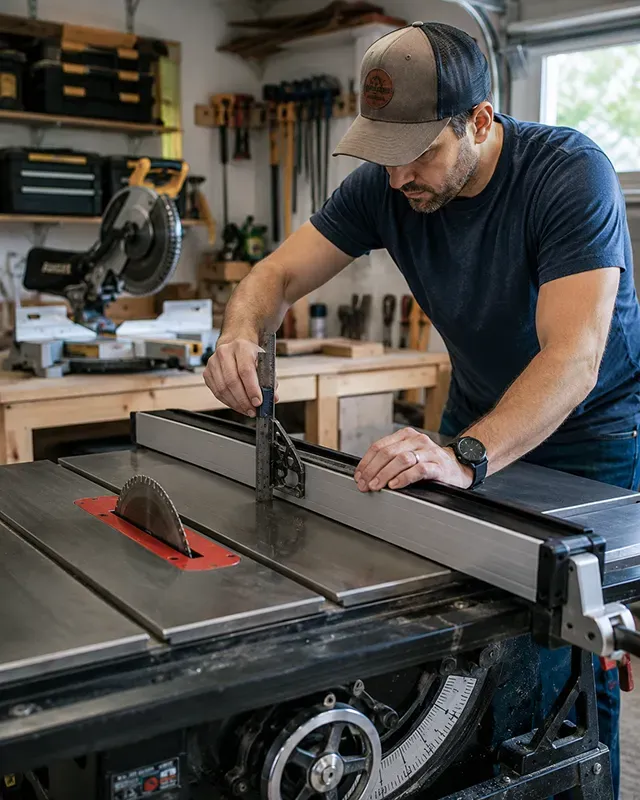
If you strip away the marketing, the performance of any table saw relies heavily on the accuracy of the rip fence. A bad fence ruins wood and creates dangerous situations; a good fence makes woodworking predictable.
When you lock the fence down, it must sit perfectly parallel to the blade. If the rear of the fence points toward the blade, or if the kerf closes behind the cut, the rear teeth can catch the workpiece and drive it back toward the operator. Understanding how kickback happens is critical before turning the machine on.
On jobsite saws, rack-and-pinion fences are one of the strongest beginner-friendly designs. This design reduces one common beginner problem: the front and rear of the fence moving independently. It still needs calibration, but it is easier to set repeatably than many loose clamp-style jobsite fences.
On larger contractor or hybrid saws, look for a heavy-duty T-square style fence. These use a heavy steel tube on the front rail and lock aggressively into place, allowing you to trust the measurement without needing to measure the distance to the front and back of the blade every time.
Table Size, Material, and Support
Aluminum tops (found on jobsite saws) are light and will not rust. However, they scratch easily, they transfer motor vibration directly into your workpiece, and magnetic jigs, such as magnetic featherboards used to hold stock against the fence, will not stick to them.
Cast iron tops require occasional waxing to prevent rust, but the extreme weight dampens vibration. Less system vibration can help the blade track more consistently through the cut, although blade quality and alignment still matter more than table material alone.
Regardless of the material, table depth matters. A small jobsite saw offers minimal support ahead of the blade. If you plan to cut large plywood panels, you will immediately need to build or buy an outfeed table to safely support the wood as it exits the blade.
Safety Features That Should Be Non-Negotiable
Modern table saws come with modular safety guards, but the most critical component is the riving knife.
The riving knife is a crescent-shaped piece of steel that sits directly behind the blade, raising, lowering, and tilting with it. A properly aligned riving knife reduces one of the main kickback mechanisms: the kerf closing around the rear teeth of the blade. It does not make a table saw safe by itself, but for a first saw, it should be treated as non-negotiable.
For a first table saw, avoid older used saws that lack a true riving knife unless you already understand splitter setups, guarding limitations, and safe ripping technique.
You will also encounter SawStop when researching options. SawStop’s active injury mitigation system detects skin contact, triggers an aluminum brake, stops the blade extremely quickly, and pulls it below the table. The mechanism is designed for blade-contact injury reduction, not kickback prevention. It does not remove the need for a riving knife, blade guard, push sticks, outfeed support, or correct fence alignment.
Do Not Judge the Saw by the Stock Blade
Many saws ship with a construction-grade or basic general-purpose blade. It may be adequate for framing lumber or rough cuts, but it is often not the best blade for clean furniture-grade ripping, plywood, or low-tearout crosscuts.
Many beginners blame their new saw for burning wood or struggling to push material through, not realizing the machine is fine—the blade is just wrong for the task.
Set aside a separate blade budget. A good first upgrade is usually a 40-tooth general-purpose blade or a 50-tooth combination blade, with the exact price depending on kerf, carbide quality, and brand. The right blade selection makes a noticeable difference in how the machine feeds, cuts, and sounds. It does not replace the riving knife, guard, push sticks, or correct feed technique.
Simple Buying Recommendations by User Type
Instead of starting with table saw brands, match the machine to your realistic working conditions:
- The Space-Limited Buyer: Choose a jobsite saw with a rolling stand if you must store the saw against a wall or move it outside to work. Prioritize a rack-and-pinion fence.
- The Furniture Beginner: Look for a contractor or hybrid saw if you have dedicated garage space. The cast iron top and induction motor will provide the stability and vibration control needed for precise joinery.
- The Safety-First Buyer: If the budget allows, flesh-sensing technology provides peace of mind regarding accidental blade contact, but you must still learn standard safety practices to prevent kickback.
- The Budget Scavenger: Avoid ultra-cheap benchtop saws if the fence cannot lock repeatably or the stand is unstable. A cheap saw that cannot make a straight cut is a waste of money.
Pre-Purchase Checklist
Before comparing table saw brands or checking out, verify these items in the owner’s manual whenever possible:
- Does it have a true riving knife?
- Does the fence lock parallel without requiring you to measure the front and back every time?
- Is the table large enough for the material you actually plan to cut?
- Can you add an outfeed support or stand?
- Does it accept the blade size you plan to use, and does the manual explicitly allow dado stacks if you need them?
- Are zero-clearance inserts or dado throat plates available for that model?
- Are blade guards, push stick storage, and anti-kickback pawls included?
- Can your shop power it safely (120V vs 220V)?
- Can you connect realistic dust collection for your shop: shop vac, dust extractor, or dust collector?
- Is there budget left for a better blade and setup tools?
Final Verdict: Buy the Saw System, Not Just the Saw
Table saw brands matter for parts availability, warranty, and safety engineering. But brand should be used as a filter, not the primary decision.
A first table saw is not just a motor and a blade. It is a system: the saw, the fence, the blade, the riving knife, the stand, the outfeed support, the dust collection, and your setup tools. A more affordable saw paired with a stable fence, a sharp premium blade, and proper outfeed support will consistently outperform an expensive saw used with a dull stock blade and no plan for supporting the wood.