
8-1/4-Inch Table Saw Blades: Why Compact Saws Use Smaller Blades
NOTE
Evidence Level: Level 0 — Theory Lab
This article explains 8-1/4-inch table saw blade mechanics using blade geometry, published specifications, and safety-standard context. It does not include physical testing of specific saw models.
A few years ago, the portable table saw market underwent a quiet but significant shift. Several compact jobsite saw lines shifted from 10-inch blades to 8-1/4-inch blades, especially in the ultra-compact category. That created a practical compatibility problem for woodworkers who already owned premium 10-inch blades.
Understanding why this change happened requires looking past the marketing brochures and digging into safety regulations, motor mechanics, and the physical limitations of portable tools. If you are choosing your first table saw, the important question is not whether 8-1/4 inches is “worse” than 10 inches. The better question is what kind of work the smaller blade actually limits.
The Regulatory and Footprint Problem
The primary reason for the shift to 8-1/4-inch blades wasn’t a sudden engineering breakthrough; it was heavily influenced by safety standards, specifically UL 62841-3-1, which governs transportable table saws.
Modern transportable table saw standards place tighter constraints on guarding, blade exposure, workpiece support, and overall saw geometry. In practice, that makes very compact 10-inch designs harder to package without increasing the table footprint. More table area in front of the blade gives the workpiece a longer registration surface before it reaches the teeth.
Reducing the blade diameter helped manufacturers keep the front-to-blade geometry and overall footprint closer to compact-saw requirements, rather than making the table substantially larger.
8-1/4 vs 10-Inch Cut Depth
The most immediate difference you will notice when stepping down from a 10-inch blade is the maximum depth of cut. Published specs show clear mechanical limits based on diameter.
Mechanically, the tradeoff is simple: an 8-1/4-inch blade gives up maximum cut height and some blade availability in exchange for a more compact saw body. For common sheet goods and 2x lumber, the difference is usually manageable. For thick hardwood, 4x4 posts, and dado work, the 10-inch platform remains more flexible.
Swipe horizontally to compare blade size tradeoffs.
| Feature | 8-1/4-Inch Table Saw Blade | 10-Inch Table Saw Blade |
|---|---|---|
| Typical saw type | Compact jobsite saw | Larger jobsite, contractor, hybrid, cabinet saw |
| 90° cut depth | About 2-1/2 in. | About 3-1/8 in. |
| 45° cut depth | About 1-3/4 in. | About 2-1/4 in. |
| Blade availability | More limited | Very broad |
| Portability | Better for compact saws | Usually larger saw footprint |
| Dado support | Usually limited or unavailable | Model-specific, more common on larger saws |
| Best use | Sheet goods, 2x lumber, garage/jobsite portability | Thicker stock, broader blade ecosystem, more flexible setups |
An 8-1/4-inch table saw blade can still easily rip 2-by dimensional lumber (which is 1-1/2 inches thick) or break down sheet goods with room to spare. The limitation becomes apparent if you frequently work with thick rough-sawn hardwoods, or if you need to cut a 4x4 post in a single pass.
When the blade is tilted to 45 degrees for bevel cuts, the 8-1/4-inch capacity shrinks to about 1-3/4 inches. This is still adequate for mitering 2x4s, but leaves very little margin for error.
Motor Load, Blade Mass, and Tip Speed
There are mechanical differences when spinning a smaller, lighter piece of steel. Portable jobsite saws rely on 15-amp universal motors. These motors are powerful for their size but lack the massive torque of heavy induction motors.
Because an 8-1/4-inch blade has less mass and a smaller radius, it generates less rotational inertia. In theory, the motor has less rotating mass to accelerate. However, the cutting load still depends heavily on kerf width, tooth geometry, feed rate, wood species, and blade sharpness. A smaller blade does not automatically mean the saw will never bog down if you feed dense hardwood too aggressively.
A smaller diameter also means a lower tip speed (or rim speed) if the arbor rotates at the same RPM. To maintain a clean cutting action, manufacturers often gear 8-1/4-inch saws to run at higher RPMs.
Actual rim speed is based on circumference, but for a simple comparison, diameter × RPM is enough because π is the same on both sides. If we look at common specifications, a 10-inch blade at 4,800 RPM and an 8-1/4-inch blade at 5,800 RPM end up closer than the diameter difference alone suggests:
- 10 × 4,800 = 48,000
- 8.25 × 5,800 = 47,850
The rim-speed math explains why a smaller blade does not necessarily mean a much slower tooth speed when the saw is geared for higher RPM. Cutting quality still depends on blade sharpness, tooth geometry, feed rate, and material.
Blade Availability and Riving Knife Compatibility
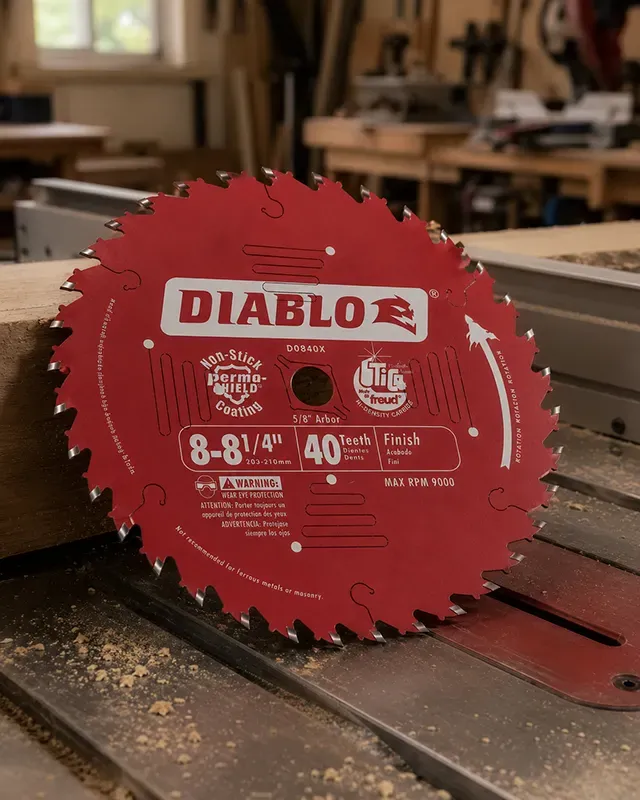
Because 10-inch has been the industry standard for decades, the market is saturated with specialized blades. Finding a dedicated 8-1/4-inch table saw blade with the correct grind, tooth count, and plate thickness requires paying closer attention to the specifications.
Table saws require a specific relationship between the blade and the riving knife:
- The blade’s kerf (the width of the cut) must be wider than the riving knife.
- The blade’s steel plate (the body) must be thinner than the riving knife.
This is why blade diameter alone is not enough. Two 8-1/4-inch blades can behave very differently if one has a standard table-saw kerf and the other is an ultra-thin circular-saw blade. If the blade kerf is narrower than the riving knife, the workpiece can bind against the knife, increasing the risk of kickback. You must always verify that any blade you purchase meets the specific kerf and plate thickness requirements stamped directly on your saw’s riving knife.
Can You Use a Circular Saw Blade on an 8-1/4-Inch Table Saw?
One of the most common questions regarding these compact saws is whether you can simply buy an 8-1/4-inch circular saw blade off the shelf.
You should not choose a blade simply because it shares the same diameter and arbor size. Before mounting a circular saw blade on a table saw, you must verify four things:
- Diameter: Must match the saw’s requirements.
- Arbor Size: Commonly 5/8-inch, but always confirm.
- Max RPM Rating: The blade’s maximum safe RPM must exceed the table saw’s no-load RPM (which can be as high as 5,800 RPM on compact models).
- Kerf and Plate Thickness: Circular saw blades often feature ultra-thin kerfs to extend battery life on cordless tools. Some ultra-thin circular saw blades can violate the riving knife tolerances, creating a dangerous pinch point.
Dado Stack Limitations
If your workflow relies heavily on cutting dadoes, rabbets, or grooves, a compact 8-1/4-inch saw will likely present a problem.
Dado support is model-specific, but 8-1/4 compact saws commonly lack it. The arbors on these ultra-compact saws are generally too short to accommodate the width of stacked blades safely. Some larger 10-inch portable saws support dado blades only with the correct dado insert and stated maximum dado width; others do not support dado stacks at all. If dado capability is a hard requirement for your shop, you will need to research specific models carefully, or step up to a larger 10-inch portable saw that explicitly supports a dado insert.
Verdict: Who an 8-1/4 Table Saw Is Actually For
An 8-1/4-inch table saw is not a weaker 10-inch saw; it is a different packaging compromise. It trades maximum blade height and blade ecosystem depth for a smaller footprint, lower rotating mass, and better portability. For sheet goods, 2x lumber, trim, shelving, and general garage-shop work, that compromise usually makes sense. For thick hardwood, frequent 4x4 cuts, dado stacks, or users already invested in premium 10-inch blades, a larger 10-inch saw remains the more flexible platform.